
Adobe's 2026 Trends Report Says the AI Problem Is a Data Problem
TL;DR
On September 10, Northern and Adobe hosted An Afternoon of CX & CJA on NOLO's rooftop in Minneapolis. Scotty Hagen from Northern, Derek Tangren from Adobe, and Dave Klein from Thrivent Funds talked through what it takes to move from Adobe Analytics to Customer Journey Analytics (CJA), then opened it up to the room.
This post connects that conversation to Adobe's 2026 AI and Digital Trends report, which found that only 44% of organizations say their data is ready for AI. Inside, you'll find:
- Why AI plans are running ahead of the customer data behind them
- Derek's advice for moving to CJA without running two systems forever
- Four practical steps to start on your analytics foundation
A few weeks ago, we spent the afternoon on NOLO's rooftop in Minneapolis with a group of marketing and IT leaders. The sky was clear, the tuna tartare and yuca fries were absolutely scrumptious, and the conversations were Minnesota nice. Some guests were still weighing a move from Adobe Analytics to Customer Journey Analytics (CJA). Others were already partway through it. Some were on other platforms entirely, and interested in learning more.

After an hour of mingling, Scotty Hagen from Northern, Derek Tangren from Adobe, and Dave Klein from Thrivent Funds kicked off the main discussion with a short lightning talk about what to know before moving from Adobe Analytics to CJA, and how to prepare your data foundation. Then the room took over. Here's one question from the crowd that resonated with us: How do you make the switch without running two analytics systems forever, when your team is already stretched?
That question is a smaller version of what Adobe found in its 2026 AI and Digital Trends report. Companies have big plans for AI. But only 44% say their data quality and accessibility are adequate for AI today.
Most of those plans depend on unified customer data that plenty of teams don't have yet. The practical way to close that gap is a staged move that starts with how you collect data. And it isn't easy when your team is already stretched.

AI plans are running ahead of the customer data behind them
Adobe surveyed 3,000 executives and practitioners for the report, along with 4,000 consumers. The gap between what companies expect and what they have in place shows up across the findings.
| What organizations expect | What's in place today |
|---|---|
| 78% expect agentic AI to handle at least half of customer support within 18 months | 16% use agentic AI for support across the organization |
| 80% say breakthrough customer experiences are highly personalized and anticipate needs in real time | 39% have a shared customer data platform that can support agentic AI |
| 76% say generative AI has improved the volume and speed of content production | 53% say their content supply chain is still largely linear and resource-intensive |
All figures from Adobe's 2026 AI and Digital Trends report.
Adobe's fourth key takeaway names the cause, a critical data infrastructure gap. 75% of organizations say data integration and quality is the top challenge for putting agentic AI to work. And 52% say their current level of data unification is holding back their AI initiatives.
Why agentic AI and faster content need a unified customer view
AI agents and content tools only know what your data tells them. If your web data lives in one tool, your call center data in another, and your CRM somewhere else, an agent ends up working with three partial customers instead of one. That's like asking a new hire to help a customer after handing them a third of the file. They'd do their best and guess at the rest.
Adobe's own roadmap reflects this. At Adobe Summit 2026, Adobe introduced CX Enterprise Coworker, an agentic AI system that draws on Adobe Experience Platform, Real-Time CDP, and Customer Journey Analytics. The agents work from the profiles and journey data underneath them. If that data is patchy, so are the results.
Content has the same dependency. Generative AI has made content faster to produce, but half of customers say marketing gets two to five seconds to earn their attention. Producing more content faster only pays off when you can see which pieces worked, across every channel a customer touches.
Measurement has the same problem. Only 31% of organizations have a framework to measure agentic AI, according to the report.
Customer Journey Analytics is Adobe's analytics application built on Adobe Experience Platform. It brings web, app, call center, CRM, and other data together so you can analyze the full customer journey in one place. For Adobe Analytics customers, it's the natural next step toward the unified view these AI plans assume.
How do you move from Adobe Analytics to CJA without running two systems forever?
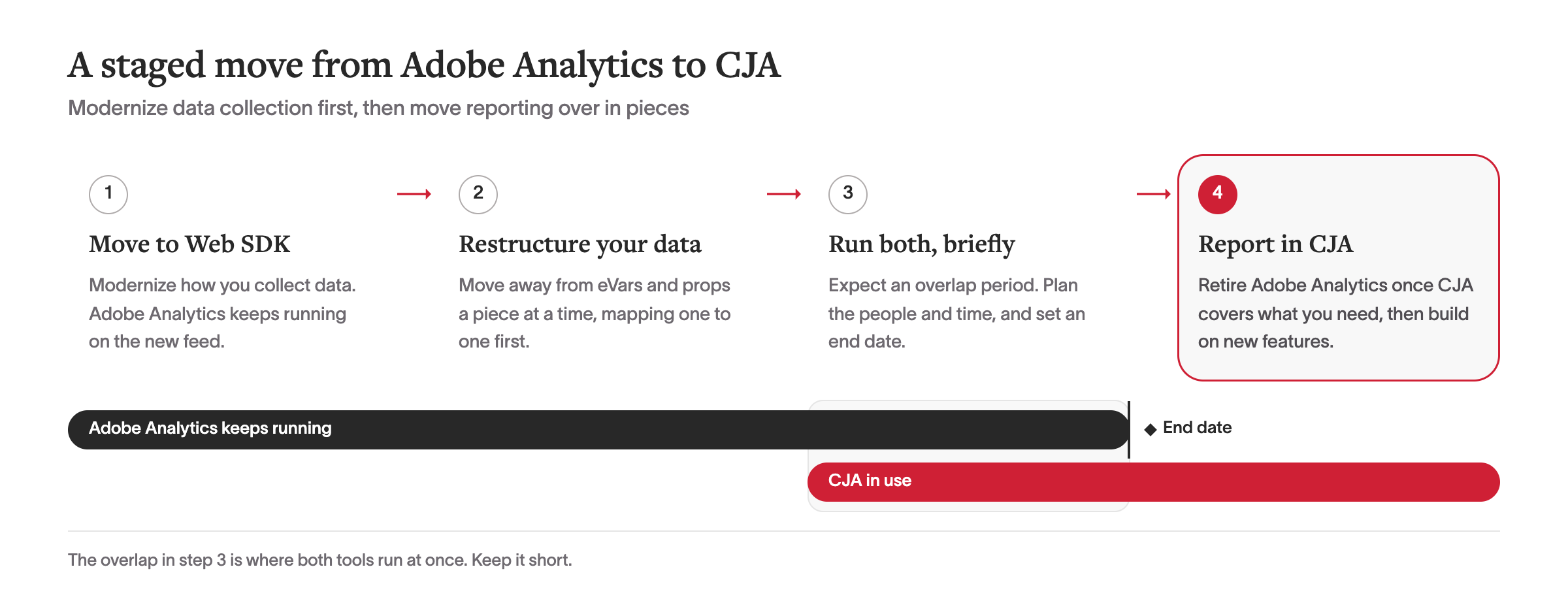
Start with how you collect data, then move your reporting over in pieces. That was the gist of Derek Tangren's answer when the question came up on the rooftop. He suggested that, for some companies, the best first step is a Web SDK migration. Adobe's Web SDK can keep feeding Adobe Analytics, so you can modernize data collection before you set up CJA. "You don't have to implement anything with CJA," he said.
Once you're ready, you can start moving away from eVars and props, the custom variables most Adobe Analytics setups are built on, and restructure your data for CJA a piece at a time.
He didn't sugarcoat the hard part. Deciding to stop collecting something, or to measure one part of the business in Adobe Analytics and another in CJA, is harder than it sounds. There will be an overlap period, and it takes people and time.
"It's harder to move away and say, okay, we're going to stop [collecting or measuring certain parts of the business in Adobe Analytics]. There's definitely an overlap period. But I'd just say be a little cautious of that, just because everyone's strapped for resources."
Derek Tangren, Senior Product Manager, Adobe
The report points to the same pressure. 57% of organizations say AI is changing work faster than employees can adapt. Another issue is the cost challenge. Asking one team to keep two analytics systems running while learning a new one is time-consuming and expensive. It's better to plan for it than to discover it halfway through.
Derek and Dave went deeper on this topic, alongside Scotty, in our webinar on moving from Adobe Analytics to Customer Journey Analytics. Their advice there was to map existing dimensions one to one first, so reports keep working and stakeholders don't have to relearn everything. Then build on new features like derived fields once you're live. The full session is available on demand if you're pondering the move.
Where to start on your analytics foundation
You don't need to solve all of this at once. A few steps make the rest simpler.
- Check your Web SDK readiness. Know what's on your site today, how it's tagged, and what it would take to move to Web SDK. Our five-minute Adobe Analytics to CJA migration assessment gives you a complexity score to start from.
- Audit your eVars and props. Decide which ones carry forward. Plenty of older variables exist because someone needed one report years ago.
- Put an end date on the overlap. Running both systems should be a phase with a finish line.
- Decide how you'll measure AI before you launch it. If you can't tie an AI project to customer journey data, you won't know if it worked.
Building the data foundation is sometimes regarded as the boring part of AI. But almost every plan in Adobe's report depends on it. The rooftop conversation was a good reminder that most teams already know what needs to happen. Finding the time and people to do it in the right order is the hard part.
If you're weighing a move to CJA, or trying to figure out whether your data is ready for AI, we'd love to continue the conversation. Or start with the CJA migration assessment and bring your results to the call.
Stay informed, sign up for our newsletter.