
How AI Is Changing the Customer Journey
When did you last ask ChatGPT or Gemini for a product recommendation? If you've done it recently, chances are your customers have too. Adobe's June 2026 research found that 86% of shoppers now use AI somewhere in their retail journey, asking assistants to find products, compare options, and summarize reviews before a brand ever knows they exist.
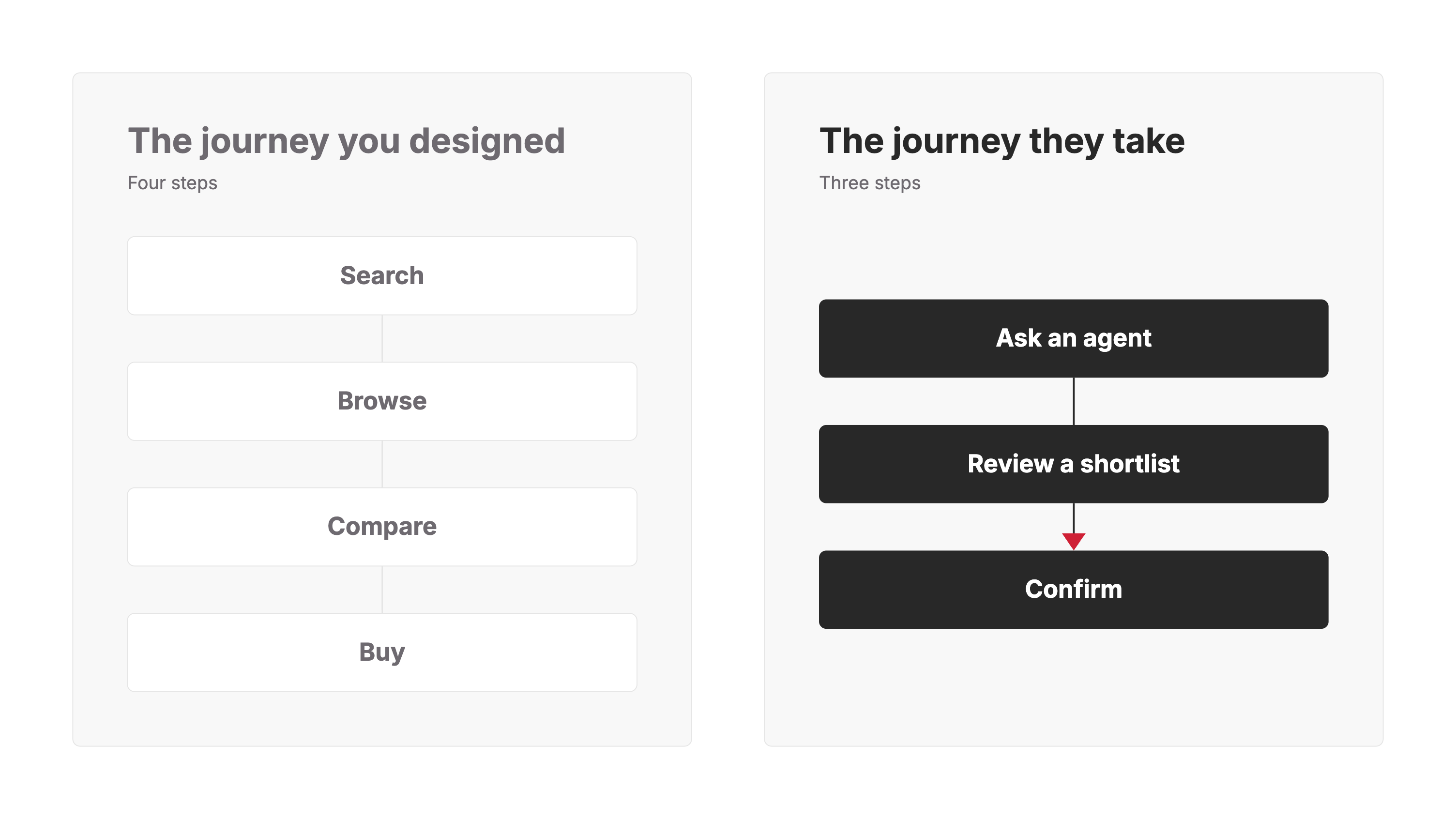
AI is changing the customer journey by moving discovery and comparison into assistants like ChatGPT and Gemini before shoppers ever click around on your site. The customer journey map on your wall doesn't show any of that. It still starts with a search bar and ends at your checkout. This isn't about AI adding polish to the journey you designed. Remember, the first steps of that journey are moving into AI prompts and conversations you'll never get to see. And the brands treating AI as a website upgrade, a smarter carousel here, a chatbot there, are optimizing a journey their customers increasingly start somewhere else.
Agentic commerce went from prediction to behaviour in a year
Agentic commerce, where AI agents search, compare, and buy on a customer's behalf, stopped being a prediction this year. In April 2025, eMarketer reported that AI agents were here but had made little real difference to how consumers actually shop. Twelve months later, retail leaders from Walmart, Lowe's, and Tesco were sitting on industry panels talking through how to operate in a world where agents already do the shopping. That is not early-adopter territory anymore. It is a behavioral shift at scale.
The journey didn't get longer. It moved. Most brands are still mapping the old one.
— Corey Dubeau, Partner and SVP, Strategy
The infrastructure tells the same story. OpenAI and Stripe built the Agentic Commerce Protocol to bring product discovery into ChatGPT. Google answered with the Universal Commerce Protocol, backed by Walmart and Target, which gives agents a standard way to read product data, place orders, and handle support across merchant systems. Companies that size don't agree on shared plumbing for a trend they expect to fade.
The question for brands is no longer whether this happens. It's how much of the journey has already moved.
AI is moving product discovery somewhere you can't see
The journey used to start where you could watch it. Search terms, landing pages, session recordings. Now it starts inside ChatGPT, Gemini, and answer engines, and the customer arrives with a shortlist already made.
Your analytics will tell you this isn't a big deal yet. That's the trap. Bain found that AI-sourced traffic is still under 1% of total traffic for most retailers, but it already drives up to a quarter of referral traffic for some. It's the smallest line on the chart and the fastest-growing one at the same time. And it converts. Amazon credits its Rufus assistant with roughly $12 billion in incremental annualized sales.
Be precise about what you can and can't see here. Google Search Console shows you every query that brought someone to your site. There is no Search Console for ChatGPT. The prompts your customers type into someone else's assistant never reach you, and they stay private to the platforms. What you can see is the output side. AI referral traffic shows up in your analytics, and visibility tools like Adobe Brand Visibility, which combines Adobe's LLM Optimizer with Semrush insights, probe the assistants with representative prompts to measure how often you get recommended and cited. Measurable is not the same as observable. You can learn your share of the answers without ever seeing the questions.
How do AI shopping agents decide what to recommend?
Agents don't get persuaded. They parse through the details your human shoppers skim past, delivery windows, return terms, fees, and spec sheets, and they judge you on whether those details hold up. A human shopper tolerates a vague delivery estimate or digs through a FAQ to find the returns policy. An agent hits ambiguity and moves to the next option, and no human ever sees that you were skipped. You have to be selectable by systems, not just persuasive to people.
Picture two outdoor gear retailers selling the same tent at the same price. One lists "ships in 2 business days, free returns within 60 days" as structured data. The other says "orders usually go out quickly" and buries its returns policy in a PDF. To a person browsing, they look interchangeable. To an agent assembling a shortlist, only one of them is safe to recommend. The same thing happens when your price or stock status differs between your site and your product feeds. An agent reads the inconsistency as risk and drops you.
What agents actually read is unglamorous. Structured product data, delivery windows, fees, cutoff times, and returns eligibility, consistent across every channel. It's the reason Adobe built a machine-readable catalog layer into Adobe Commerce aimed squarely at AI crawlers and LLM-powered discovery. And McKinsey's research shows where this bites first. Delegation grows fastest for low-regret purchases like replenishment and essentials, and stalls where identity and emotion drive the choice. If you sell things people reorder, agents are already in your category.
Your customers don't trust the agents yet. That's your opening.
The hype says autonomous shopping has arrived. The data says customers are holding back. Adobe found shoppers' top concerns about AI shopping are privacy at 29%, biased recommendations at 24%, and a plain lack of trust at 23%. The friction is real too. Nearly one in five shoppers abandons an AI request because they don't know how to ask for what they want, and most give up after about three attempts. People want the help. They just can't always get it.
The assistants have their own problems. They get brands wrong. Harvard Business Review opens its analysis with Pernod Ricard discovering that LLMs were feeding consumers inaccurate information about its brands, and no one at the company had been watching.
Then comes the stat that reframes all of it. Bain found customers trust a retailer's own AI agent three times more than a third-party one. Sit with that for a second. The tools are new, the behaviour is growing, and your customers would still rather get AI help from you than from ChatGPT.
The trust gap isn't a reason to wait. It's a head start. Third-party agents will earn credibility, the friction will get engineered away, and the gap will close. The brands that use this window will be the ones customers already trust when the agents start doing the buying.
What to fix first
Ask the agents about yourself. Open ChatGPT, Gemini, and Microsoft Copilot. Ask what they recommend in your category, then ask about your own products, prices, and policies. It costs nothing, takes an afternoon, and most brands have never done it. When you're ready to check continuously instead of once, tools like Adobe Brand Visibility turn that afternoon audit into an ongoing dashboard.
Make yourself machine-readable. Structured product data, explicit delivery terms, and consistent returns policies across every channel. This is the least exciting work on the list and the work that pays off most. It also improves your own site search and product feeds, so none of it is wasted if agentic volume arrives slower than projected. It also includes the files agents check before they read a single page. You already keep a robots.txt for search crawlers. An llms.txt plays the same role for AI systems, a plain text file at your site root that points them to your most important content, policies, and product information. It's an emerging standard rather than a guarantee, but it takes about an hour and it's often the first thing a readiness audit looks for.
Decide your agent strategy on purpose. Start with the search box you already have. Your visitors get conversational answers from ChatGPT all day, then arrive at a site that makes them type keywords into a box. Upgrading on-site search and discovery, from intent-based search through a conversational agent like Adobe Brand Concierge, is the first owned-agent investment for most brands, and the trust advantage makes now the time. Beyond your own site, third-party surfaces buy you reach but risk turning you into a commodity. Most brands will need some of both. The mistake is letting the default decide for you.
None of this means the funnel is dead or that your website stops mattering. It means the part of the journey where customers make up their minds is moving somewhere new, the way it moved to search twenty years ago and to mobile ten years ago. The brands that won those shifts weren't the ones with the biggest budgets. They were the ones that took the shift seriously while their competitors called it a trend.
Right now your customers trust you more than they trust the agents. That advantage is real, and it's temporary. If you're working out what AI means for your customers' journey, we'd love to continue the conversation.
Stay informed, sign up for our newsletter.