Beyond GA4: Use Cases Adobe Customer Journey Analytics Solves That Your Stack Can't

Author
Scotty Hagen
Partner and VP, Data and Analytics
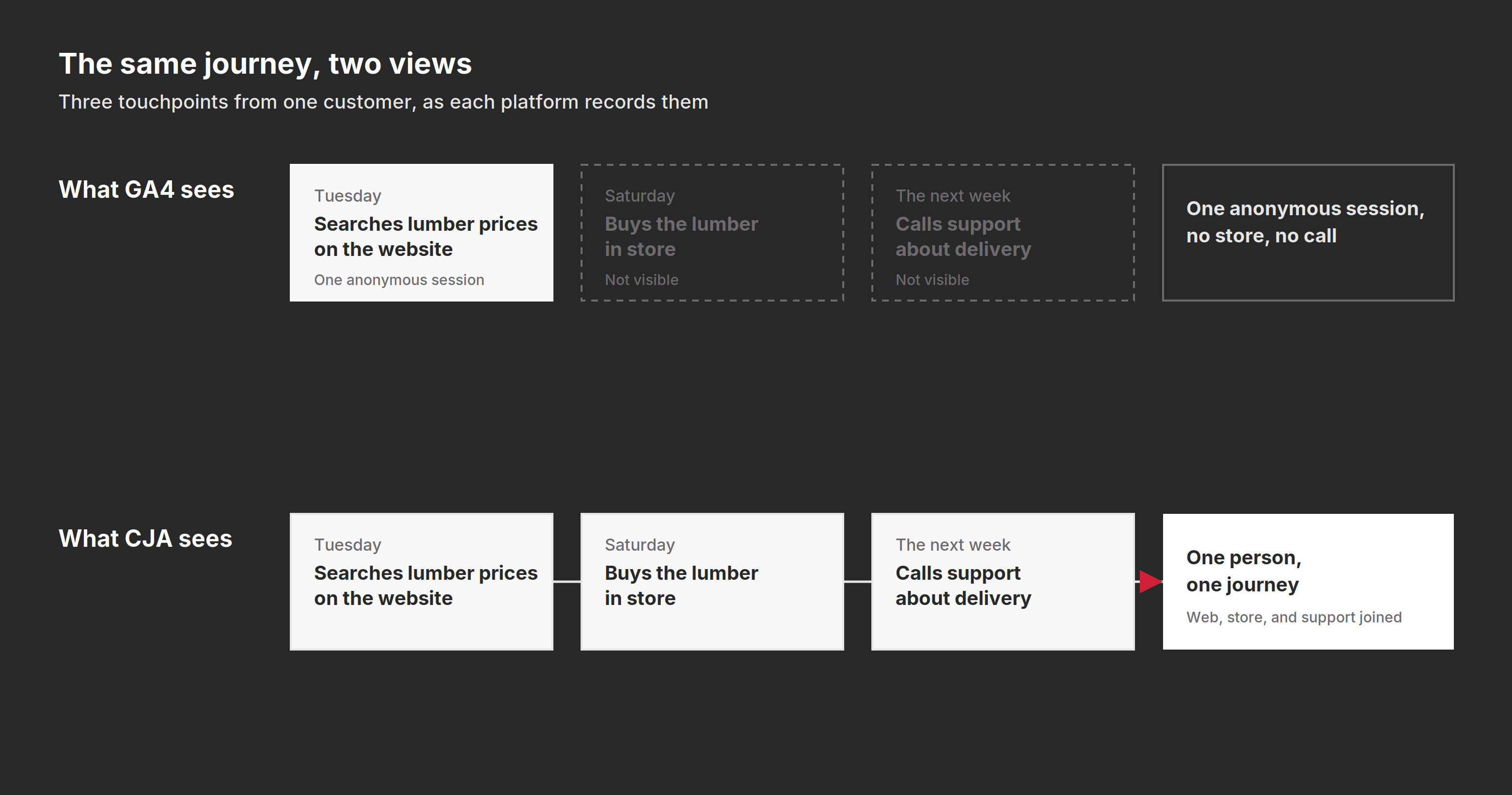
If you know me, you'll know that I love talking about real-life use cases. Here's one I've encountered in the past with a Fortune 500 retailer that was facing a major pain point. A customer searches lumber prices on the retailer's website on a Tuesday. That same customer walks into a store on Saturday and buys the lumber. A week later they call support with a delivery question. Through the lens of GA4 (Google Analytics 4), that journey is one anonymous web session. The store visit and the phone call never happened. There's no way to stitch that one customer's journey back together.
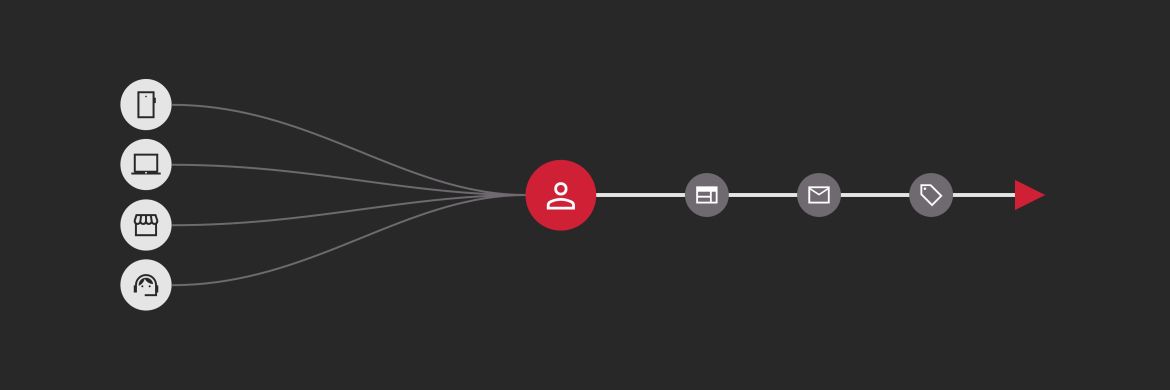
I hear the GA4 versus Adobe Analytics question a lot. The honest answer is that Adobe Analytics is still around, but Adobe Customer Journey Analytics (CJA) is where Adobe is putting its analytics future. So if you're weighing GA4 against Adobe today, CJA is the real comparison. And it's a different kind of comparison. CJA analyzes every interaction a person has with your business, online and offline, all in one cohesive place. GA4 analyzes your website and app. That gap sounds abstract until your CEO asks a question that lives across both.
Below are five use cases I see clients need that GA4 can't handle, plus an honest opinion on when GA4 is still the right tool.
Where GA4 hits its limits
Before I start getting into the use cases, it helps to name the walls. GA4 has four.
Cardinality: When a dimension has too many unique values, GA4 groups the long tail into a row labeled (other). Your most detailed data becomes your least usable data.
Sampling: Standard GA4 samples any exploration that queries more than 10 million events. The bigger your question, the fuzzier your answer.
Thresholding: GA4 withholds rows when user counts run low, which is exactly when you're studying a niche audience.
Retention: Standard properties keep event data for explorations for 14 months at most, and the default is two. Year-over-year journey analysis dies at that wall. Aggregated reports survive, but you can't build new segments on old data.
The standard advice for all four walls is the same. Export to BigQuery. That advice carries a lot of weight. You inherit data modeling, SQL, joins, and dashboard builds. It's not a checkbox. It's a data engineering project with ongoing costs, and most teams find that out after they've committed. Google Analytics 360 raises some of these ceilings, with sampling limits of 1 billion events and retention up to 50 months. But it's the same digital-only platform underneath.
| Capability | GA4 (standard) | GA4 360 + BigQuery | Adobe CJA |
|---|---|---|---|
| Cardinality | High-value dimensions collapse into the (other) row | 360 raises the limits, BigQuery holds raw rows you query yourself | Full-fidelity dimensions, no (other) row |
| Sampling | Explorations sample past 10 million events | 360 extends to 1 billion, BigQuery is unsampled but hand-built | Unsampled at any scale |
| History | Explorations capped at 14 months, default two | 360 extends to 50 months, BigQuery keeps what you pay to store | Set by your data retention policy, not a product ceiling |
| Offline data | Measurement Protocol only, 72-hour window, no analysis surface | Same collection limits, joins built manually in BigQuery | Native, any dataset with a shared identifier |
| Attribution | Last click and data-driven only | Same models, custom attribution rebuilt in SQL | Multiple models, report-time, retroactive, offline included |
| Identity | Blended signals with modeled gaps you can't inspect | Raw identifiers in BigQuery, stitching is yours to build | Configurable stitching to one person, retroactive |
Building a single customer view across every channel
Sooner or later a CEO asks how much of your store revenue starts on the website. If your stack is GA4, nobody in the room can raise their hand to answer confidently. Not because the team is weak, but because the data needed to answer was never joined in the first place.
That's the problem a single customer view solves. It means every interaction a person has with you, joined to one profile you can actually analyze. It's impossible for GA4 to build that as it's digital-only by design. User properties are limited to what GA4 itself collects, so your CRM status, loyalty tier, store purchases, and support history stay outside.
CJA takes any dataset with a shared identifier. Loyalty records, point of sale, call logs, email engagement, even weather data if it matters to your business. If it joins on an ID, it can sit in the same analysis as your web behavior.
The difference shows up in the questions you can ask. Whether loyalty members browse differently before a store purchase. Whether a support call in the first month predicts churn. In GA4 those questions have no home. In CJA they're a drag and drop.
Adobe's published case study on The Home Depot credits unified customer profiles for a 62 percent year-over-year increase in personalized campaigns. That's the practical payoff. Personalization runs on profiles, and profiles run on joined data.
Call center analytics alongside web behavior
Every call your website causes is money. I've worked inside financial services, where a support call can cost 20 dollars once you count staffing and time. If a confusing digital flow drives a thousand calls a month, that's a real line on someone's budget, even if nobody has connected it to the website yet.
GA4 can't make that connection in any usable way. Its Measurement Protocol can technically send an offline event, but records older than 72 hours get dropped, and even the ones that land give you no way to analyze call patterns against digital journeys. CJA joins them. Adobe's own use case library describes a financial institution that found its five-step mobile claim process was driving call volume. The team could see which digital dead ends preceded calls, build an audience of the users who hit them, and fix the flow. That's the repeatable pattern. Find the dead ends, quantify the calls they cause, fix the experience, and measure the drop. Call deflection is one of the cleanest ROI stories in call center analytics because the cost line already exists.
Attribution you can configure and check
In 2023 Google removed first click, linear, time decay, and position-based attribution from GA4. Two models remain, last click and data-driven. Data-driven is a black box. You can't see how it assigns credit and you can't tune it. I like AI-assisted models fine, but directional is not the same as right, and you can't check the work on a model you can't open.
That's why teams end up shopping for marketing attribution software as a separate line item. With CJA it's built in. Attribution is applied at report time, so you can compare models side by side, change lookback windows, and apply any of it retroactively to your full history without reprocessing anything.
And because offline touchpoints live in the same dataset, a sales call or a store visit can carry credit alongside a paid click. That's cross-channel attribution in the literal sense, not the brochure sense.
Omnichannel analytics without stitching spreadsheets
Most omnichannel analysis today is a person exporting five reports from five tools and reconciling them in a spreadsheet. Every analyst reading this has done it. The numbers never quite agree, and by the time they do, the question has changed.
CJA's answer is report-time processing. Session definitions, segments, and attribution settings apply when you run the query, not when the data is collected. Change a session definition today and it applies to your entire history instantly. In GA4, configuration changes only affect data going forward, so every mistake is permanent and every improvement starts from zero.
Report-time processing also means different teams can read the same data differently. Marketing runs customer behavior analytics in its own data view, support gets another, finance gets a third, all from one implementation.
One tip from experience. Where companies get bogged down is they try to boil the ocean. Start with two data sources that answer a real question, like web plus call center. Prove it, then add the next source. The platform doesn't force sequencing, so your partner has to. A partner who can't sequence the work is a red flag.
Identity resolution across devices and channels
Identity resolution is how analytics decides that a phone visit, a laptop purchase, and a support call are the same person. Obviously, it's important to get this part right, because get it wrong and every number downstream is wrong, from conversion rates to audience counts.
CJA uses identity stitching. Interactions across devices and channels link to one person through identifiers you choose, which produces person counts you can defend. GA4 blends several identity signals and fills gaps with modeling, and you can't inspect how much of a report is observed versus modeled.
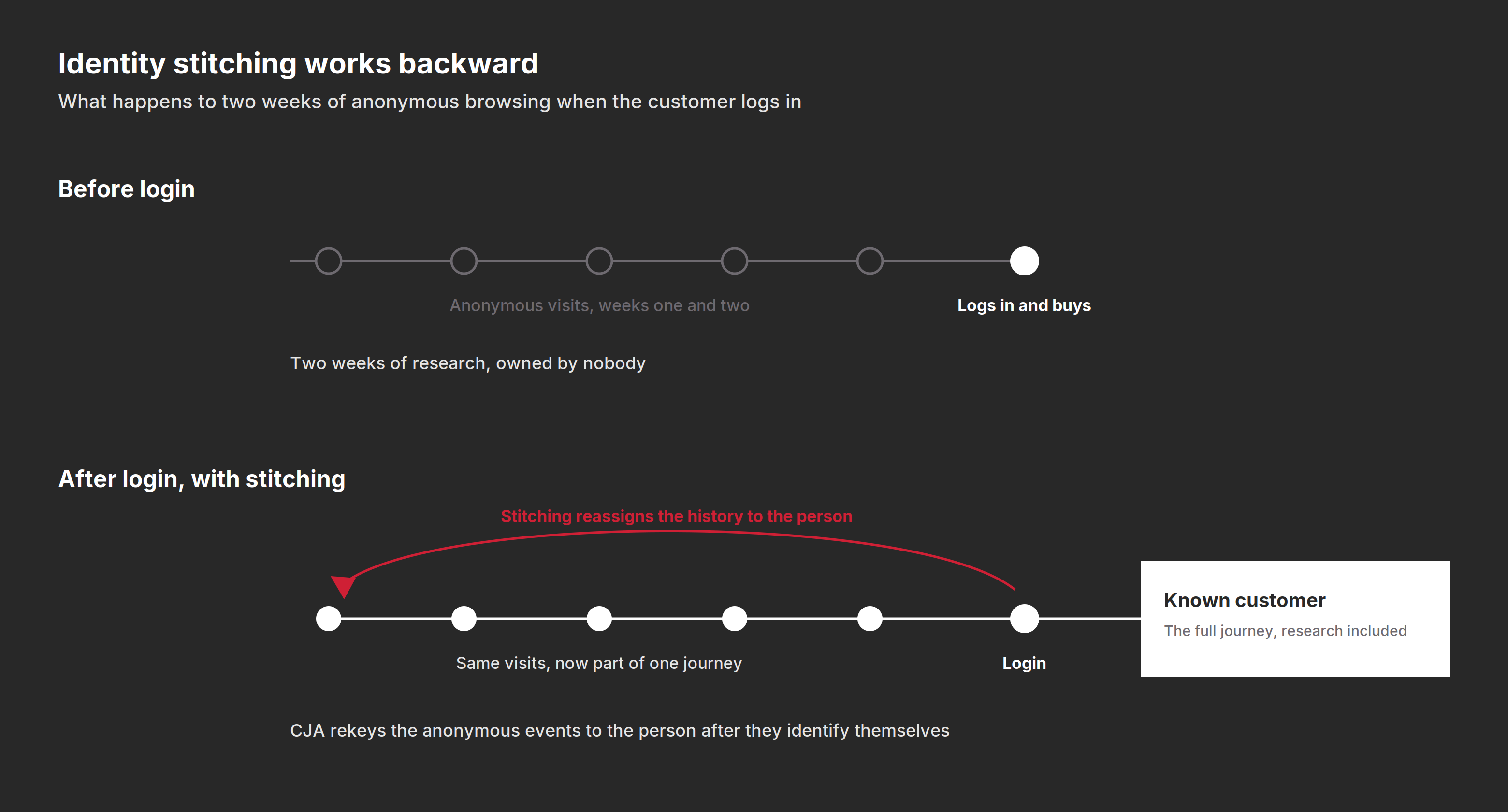
Here's what that looks like in practice. A customer browses your site anonymously for days, then logs in to buy. Stitching goes back and reassigns that anonymous browsing to the person who just identified themselves. All the research that led to the purchase becomes part of their journey instead of belonging to a stranger. GA4 can't do that retroactively, so the journey starts at login and everything before it is a different person.
This matters more every year as third-party cookies fade. CJA runs on first-party, consented identifiers, which is the durable foundation. For Canadian businesses, that consented first-party approach is where privacy laws like Quebec's Law 25 are pushing everyone anyway. The longer you wait to build on first-party identity, the fewer options you'll have.
Where GA4 is still the right answer
I'm not going to tell you GA4 is bad. It's free, it deploys in a day, and connects natively to Google Ads. If your business is one website, your journeys are digital only, and your questions are about traffic and conversions, GA4 is probably enough.
CJA is an enterprise tool with enterprise prerequisites. It runs on Adobe Experience Platform, it needs real schema design up front, and the implementation is a project that takes many weeks, not a single afternoon. If you want to see what that move actually involves, our on-demand CJA migration webinar walks through it with an Adobe product manager and a client who has done it.
The honest decision rule is about your journeys, not your tooling preferences. If every customer interaction happens on one digital property, GA4 may cover you enough. If your customers cross channels GA4 can't see, the gap between what you know and what's happening compounds every quarter.
Turning use cases into revenue
Every use case above is a revenue lever. Call deflection cuts a cost line your finance team already tracks. Attribution moves spend to the channels that earn it. And a single customer view is what personalization runs on, which is what moved the number at The Home Depot. Adobe's case studies tell the same story elsewhere. OTTO credits the optimizations CJA made possible with measurable sales increases, and Coca-Cola's e-commerce team used it to put revenue numbers behind every recommendation they shipped.
The products we recommend have to be backed by revenue numbers.
— Vinay Gopinath, Global Director of Advertising and Marketing Technology Platforms, The Coca-Cola Company
Northern implements CJA end to end, from Experience Platform schemas to the data views your teams actually use. If your customers are crossing channels your analytics can't follow, we'd be glad to continue the conversation. Bring the question your current stack can't answer. That's usually the best place to start.
Stay informed, sign up for our newsletter.