

Agentic Commerce Readiness Assessment
Find out where you stand on UCP and ACP before you commit to a build.
A complimentary readiness assessment for merchants on platforms without native UCP and ACP support. We scan your site against each protocol and tell you exactly what is ready, what is not, and what you need to close the gap.

- 1,219% Growth in AI-referred traffic to US retail sites since October 2024
- 28% Higher add-to-cart rate from AI-referred visitors
- 60% Higher conversion than non-AI traffic
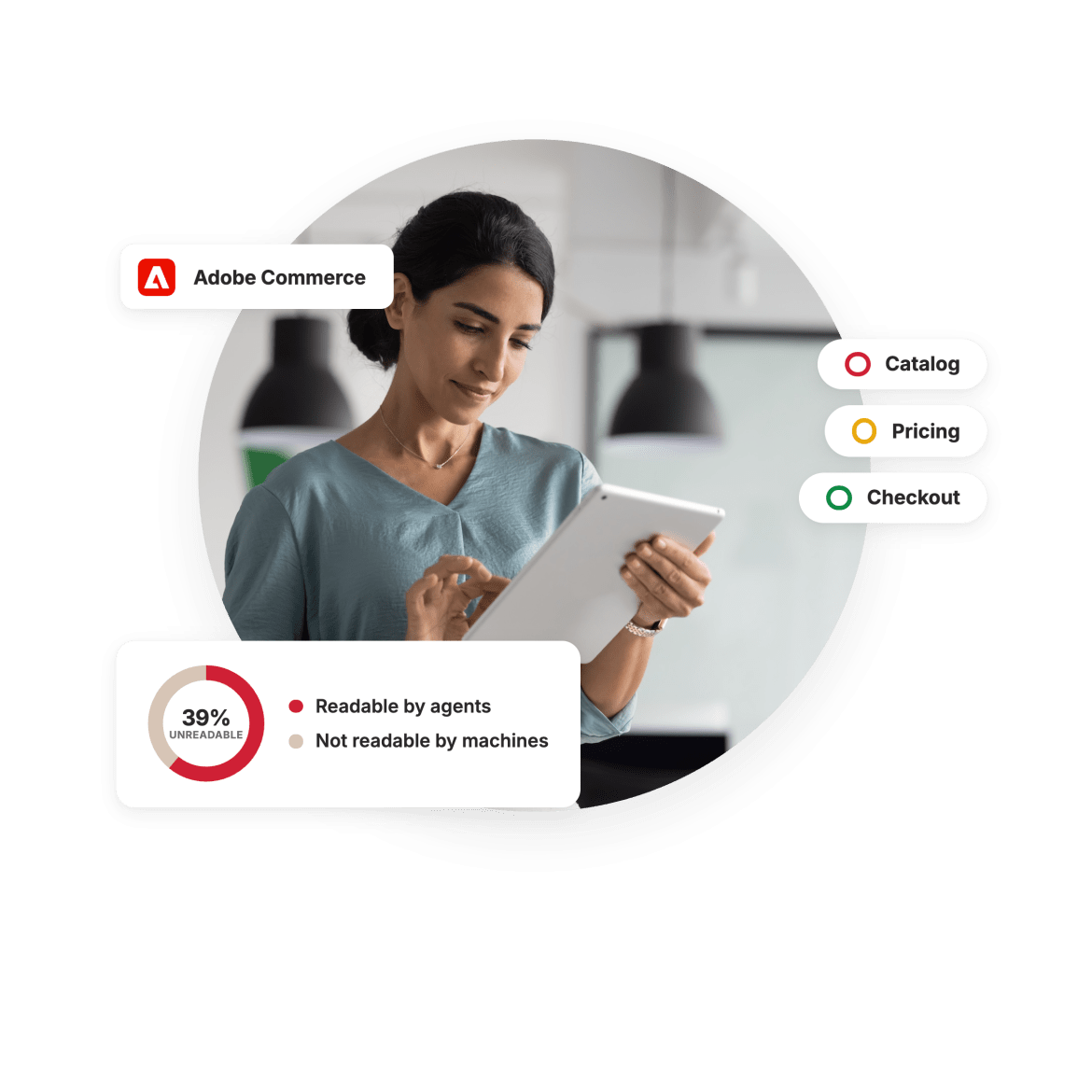
- 39% Of retailer homepage content is not readable by machines
YOUR PLATFORM
Which platforms support UCP and ACP today?
If you are on Shopify, UCP and ACP are already supported natively, so the protocol work is largely handled for you. The question worth asking instead is how much of your content AI agents can actually find and read, which is what our GEO assessment measures (opens in a new tab).
If you are on Adobe Commerce or Magento, particularly a legacy PaaS build, the situation is different: Adobe has committed to both protocols, but the capabilities are still listed as coming soon. Until they land, readiness is something you have to build and verify yourself.
That is the gap this assessment is designed for.
Not sure which applies to you? Submit a request anyway and we will point you to the one that fits.
What AI agents see when they land on your site
The traffic shift happened faster than most merchants noticed, and it brought better customers with it. AI-referred visitors convert at a rate 60% higher than non-AI traffic, because they arrive already informed.
The problem is that an agent can only recommend what it can read. If your catalog is not machine-readable, you are not in the answer it gives. That gap is what the assessment measures.
Inside the assessment
What lands in your inbox
We scan your site the way an AI agent would, then walk you through what we found. You get a picture of where you stand on both protocols and what it would take to go live on either one.
Your current readiness, by protocol
What machines can actually see
The gaps that matter
What it takes to close them
Four questions worth asking yourself
These are the questions we open every discovery conversation with. If you can answer all four confidently, you are in better shape than most.
How much of your product catalog is actually readable by an AI agent?
Not how much renders in a browser. How much is available as structured data rather than sitting behind JavaScript.
Are you seeing AI-referred traffic in your analytics yet, and do you know how it converts?
Most merchants have it. Far fewer have it segmented.
Does your commerce platform support UCP or ACP today?
Committed to supporting is not the same as supporting.
Are your competitors turning up in AI shopping results?
And do you know whether you are?
If any of those gave you pause, that is what the assessment answers.
Request your UCP and ACP assessment
Tell us where to find you and we will take it from there. Requesting an assessment does not commit you to anything.
"Most stores we scan are built beautifully for people and almost accidentally for machines. The gap between those two is usually smaller than merchants fear, but you cannot scope it until someone has looked."

Common questions we get about UCP and ACP
The Universal Commerce Protocol (UCP) is a standard that makes a merchant's product catalog, pricing, and inventory readable by AI shopping agents. It defines how that information is exposed so an agent can find and evaluate products without a human navigating the store.
In practice, it is the difference between an AI agent being able to recommend your products and not knowing they exist.
The Agentic Commerce Protocol (ACP) is a standard for how an AI agent initiates and completes a purchase on a shopper's behalf. Where UCP makes your catalog readable, ACP makes your checkout usable by an agent acting for a customer.
The two are complementary, not interchangeable.
UCP defines how a merchant exposes catalog, pricing, and inventory so an AI agent can read it. ACP defines how an agent initiates and completes a transaction on a shopper's behalf. UCP is about being readable. ACP is about being transactable.
You do not automatically need both. Which one matters most depends on your platform, your category, and where your customers' agents are coming from. That is one of the things the assessment answers.
Adobe has committed to supporting both protocols, but the capabilities are not generally available yet. Adobe's own announcement describes the work as moving toward support, with additional capabilities planned through the year, and publishes no dates.
Until they ship, merchants on Adobe Commerce and Magento are responsible for their own readiness. That is the main reason this assessment exists.
Schema markup helps machines understand what a page is about. UCP and ACP go further: they let an agent complete a transaction. Good structured data is a prerequisite, not a substitute.
If your schema is already solid, you have a head start on readiness rather than a finished job.
Both protocols are designed with authentication and authorization at the transaction layer, so an agent acts only within permissions the merchant defines. Nothing in either standard requires you to open your checkout to unauthenticated automation.
Security review is part of any implementation we scope, and the assessment flags anything in your current setup that would complicate it.
AP2, the Agent Payments Protocol, covers how payments are authorized and settled when an agent transacts on a shopper's behalf. It sits alongside UCP and ACP rather than replacing either: UCP handles discovery, ACP handles the transaction, AP2 handles the payment rails underneath.
This assessment focuses on UCP and ACP readiness, which is where the work sits for most Adobe Commerce and Magento merchants today. If AP2 is relevant to your setup, we will flag it.
It depends on your platform and the state of your catalog data, which is what the assessment establishes. Once scoped, most mid-market implementations are measured in weeks rather than quarters.
The assessment itself is where that estimate comes from, so you are not committing to a timeline before anyone has looked at your store.