Does Adobe Commerce Have UCP? What Merchants Need to Know
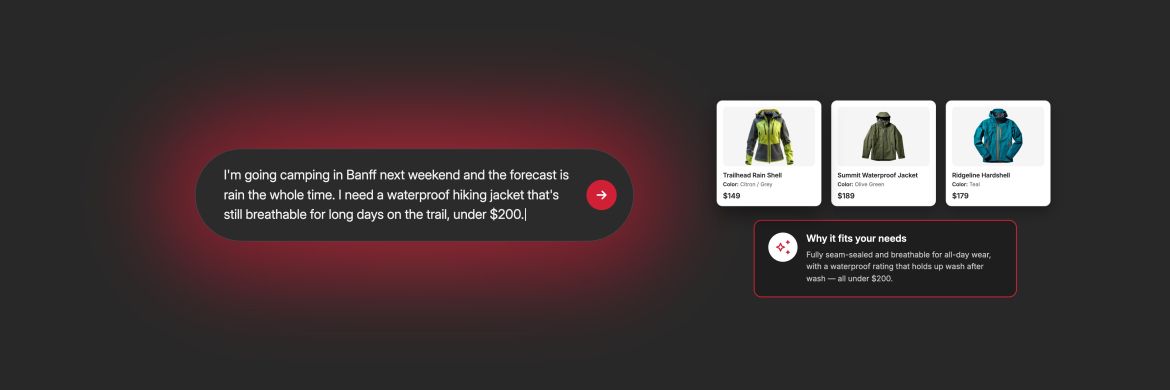
In January, we wrote about what agentic commerce is and why it matters. Even then, agents shopping on our behalf wasn't a flash-in-the-pan prediction. ChatGPT had launched in-chat checkout months earlier, and AI traffic to retail sites had just broken records over the holidays.
What was missing was a common language. Every commerce platform that wanted to work with AI assistants needed its own custom connection, and most had none at all. That's the part that changed. In the six months since our first post, the industry has converged on open standards for how AI agents talk to ecommerce stores. The biggest one is the Universal Commerce Protocol, or UCP. Platforms have picked their positions, and if you run on Adobe Commerce, you've probably noticed Shopify making a lot of noise about its head start.
Here's what UCP actually is, where Adobe Commerce stands, and what you should do about it.
What is the Universal Commerce Protocol (UCP)?
In ecommerce, UCP stands for Universal Commerce Protocol, an open standard developed by Google together with major commerce players, including Shopify, Amazon, Walmart, Target, and Etsy. It gives AI agents a common language for talking to online stores. It was announced at NRF 2026 and is endorsed by dozens more companies, including Visa, Mastercard, and PayPal.
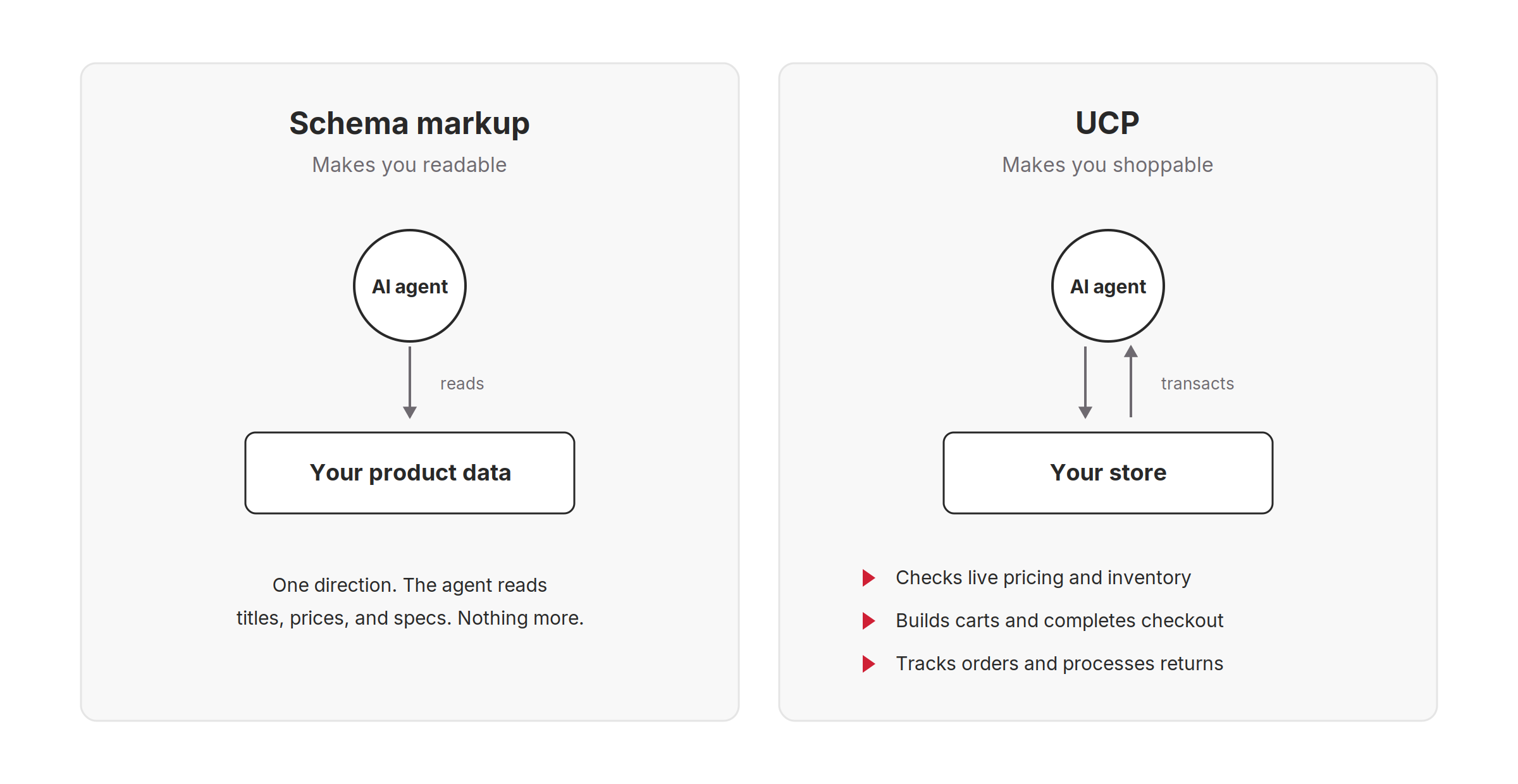
You can think of UCP as schema markup for AI agents. That gets you halfway there. Schema markup helps a machine read your product data. UCP lets a machine act on it. Through UCP, an agent can check live pricing and inventory, build a cart, complete checkout, track an order, and process a return. So the difference is, schema makes you readable, but UCP makes you shoppable.
The mechanics are simple on the surface. A merchant publishes a standard file on their domain that describes what their store can do, which endpoints to call, and how to authenticate. Any UCP-compatible agent can read that file and start transacting. No custom integration required for each assistant.
One design choice matters more than the rest. UCP keeps the retailer as the seller. Your pricing, your customer relationship, and your commerce data stay yours.
Why UCP matters now
The shift this standard supports is already showing up in the numbers.
According to Adobe Analytics, traffic to U.S. retail sites from generative AI tools grew 693% year over year during the 2025 holiday season, and it kept climbing into 2026, up another 393% in the first quarter. The quality of that traffic changed even faster. In March 2025, AI-referred visitors converted 38% worse than channels like paid search and email. One year later, they converted 42% better, a record in Adobe's data.
The same report flags the catch. The average U.S. retail homepage is only 75% readable by AI models, which means a quarter of its content is invisible to the very tools sending that traffic.
In other words, the traffic source with the best conversion rate on the internet is the one most merchants haven't built for yet.
UCP vs. ACP, two standards with one job
UCP isn't the only protocol in play, and that detail matters for the rest of this article.
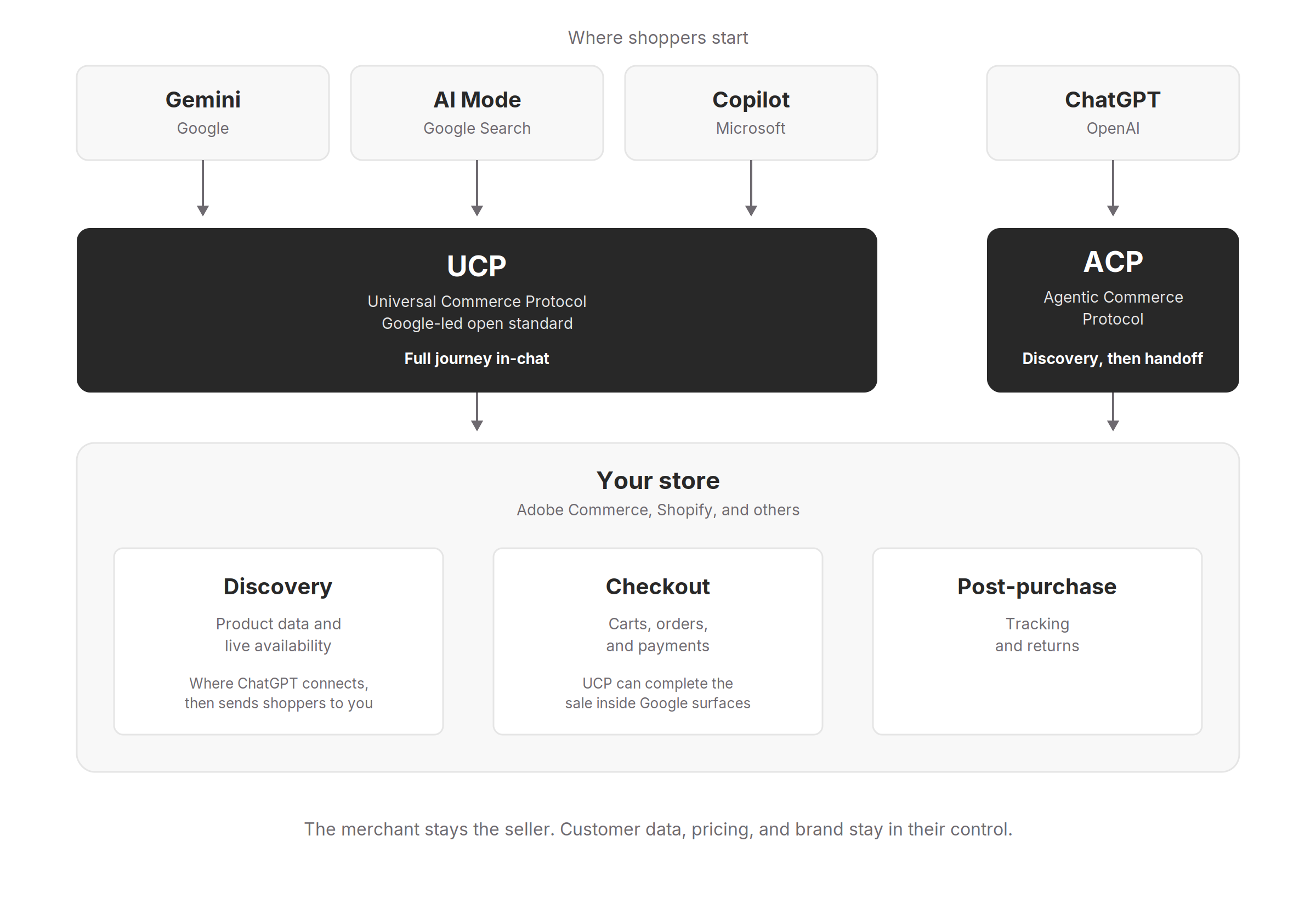
UCP is the Google-led standard. Google's UCP currently powers shopping inside Gemini and AI Mode in Google Search, and with Microsoft and Meta among its co-developers, their assistants are the obvious next surfaces. Klarna has endorsed the standard for its shopping assistant. Payments on the Google side are authenticated through a companion standard called the Agent Payments Protocol, or AP2.
ACP stands for Agentic Commerce Protocol, a separate open standard built by OpenAI and Stripe. It launched powering in-chat checkout inside ChatGPT. But in March 2026, OpenAI moved ChatGPT to a discovery-first model, after finding that shoppers liked discovering products in the chat but preferred to finish the purchase on the merchant's own site, where it converted better. ACP now surfaces your products inside ChatGPT and sends the shopper to your store to buy. So the sale, the payment, and the customer stay with you.
Security works the same way across these standards. Every purchase is authorized by the shopper, and where an agent does complete a sale, like UCP inside Google's surfaces, authentication layers such as AP2 make sure no agent buys anything on its own. For merchants, that keeps every agent-led purchase consented to and auditable.
So the two standards now cover different ends of the journey. UCP can carry a sale start to finish inside Google's surfaces. ACP gets your products discovered in ChatGPT, then hands the shopper to your store to close. A store that only supports UCP misses ChatGPT's discovery. A store that only supports ACP misses Google. You want both.
Claude has no native shopping surface yet and hasn't joined the UCP coalition, but UCP builds in Anthropic's Model Context Protocol as one of its transports. That means agents built on Claude can already discover and transact with UCP merchants.
Does Adobe Commerce as a Cloud Service (ACCS) have UCP?
The short answer is yes, support is committed and rolling out. Here's the longer answer.
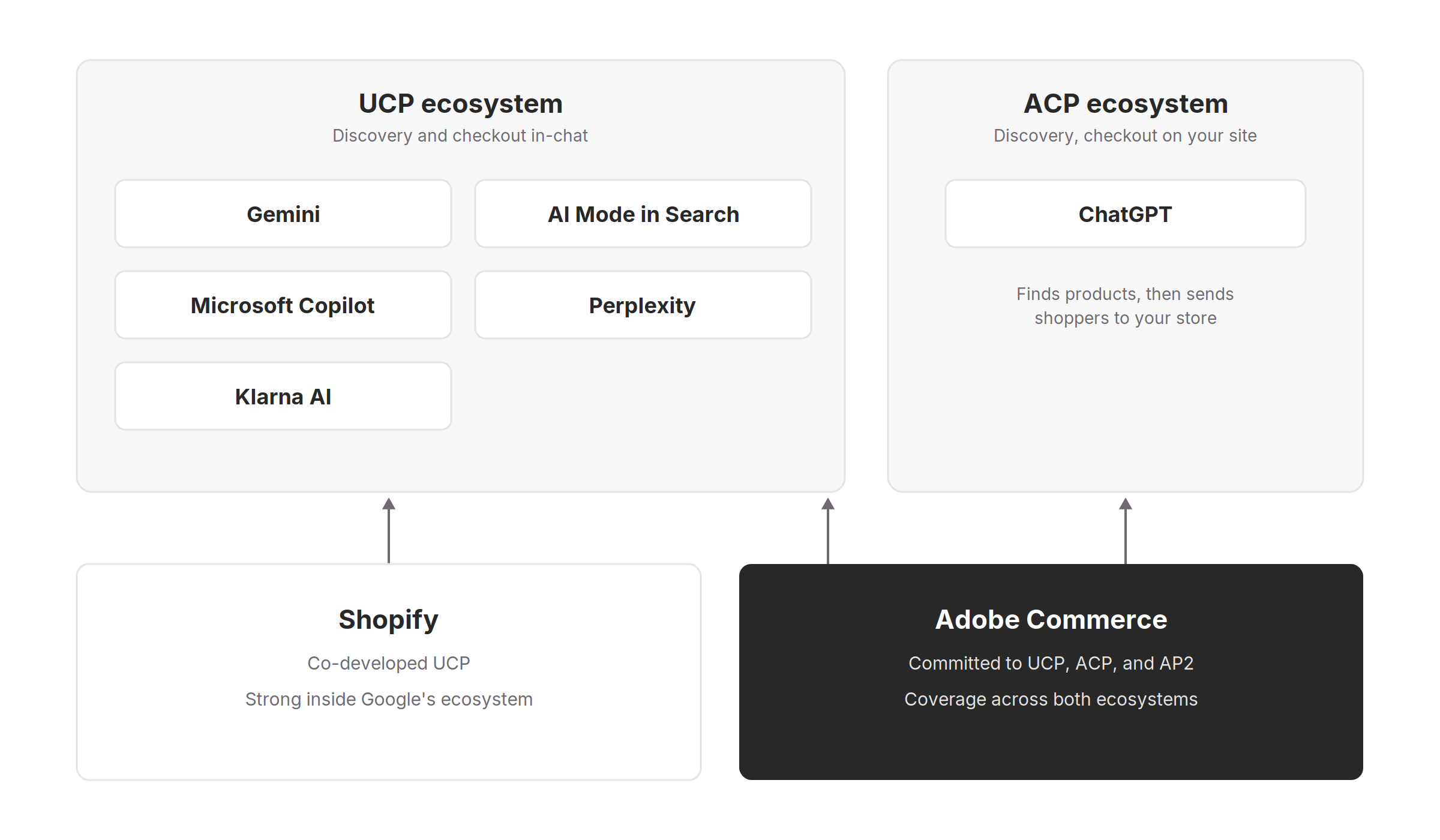
In February 2026, Adobe announced that Adobe Commerce (formerly Magento) will support both UCP and ACP, building on its earlier commitment to AP2. In Adobe's words, the goal is that brands "can participate wherever agent-led shopping happens." Native support for both protocols is coming to Adobe Commerce on Cloud, Adobe Commerce as a Cloud Service (ACCS), and Adobe Commerce Optimizer.
That commitment sits on top of work shown at Adobe Summit this spring. ACCS can now enrich product data automatically and generate structured feeds built for LLMs to consume. A new Commerce MCP server gives developers real-time access to catalog, cart, pricing, and checkout, so brands can build their own agent experiences instead of waiting for someone else's. And payment partnerships with PayPal, Stripe, and Adyen are extending agent-driven checkout to surfaces like Perplexity and Copilot.
Your next big customer might not have eyes. If your product data only makes sense to a human staring at a product page, the agent could move on.
— Beau Brewer
ACCS vs. Shopify on agentic commerce
This is the comparison everyone is searching for, so let's be straight about it.
Shopify helped write UCP, and that head start is real. If your only goal is to show up in Google's agent ecosystem as fast as possible, Shopify has the inside track today.
Adobe took a different path. Rather than co-authoring one standard, it committed to all three: UCP for Google's surfaces, ACP for discovery in ChatGPT, and AP2 for payment authentication. For merchants, that means coverage across both major agent ecosystems rather than depth in one.
The platforms also serve different merchants. ACCS is built for complex catalogs, B2B workflows, and businesses that need fine-grained control over pricing, promotions, and data. Those are exactly the merchants who can't afford to hand their commerce logic to a third party. Adobe's framing of agentic commerce keeps storefront, pricing, and fulfillment under the brand's control, and that posture matters more as agents take over more of the journey.
So the honest answer to "ACCS or Shopify for agentic commerce" depends on what you're optimizing for. Speed into one ecosystem, or breadth across all of them with enterprise-grade control. For most of the merchants we work with, the second one wins.
How to prepare your catalog for agentic commerce
The standards are still maturing, but the preparation work is useful no matter how they evolve. Agents can only sell what they can understand, so readiness starts with your data.
- Clean up your product data. Complete attributes, standardized units, accurate specs, and plain-language descriptions.
- Make sure your catalog APIs expose full product information, including variants, pricing, and live inventory.
- Add or audit structured data on your product pages. It's not UCP, but it feeds the same machines.
- Start tracking AI-referred traffic in your analytics so you can see this channel grow.
None of this is wasted effort. Clean data and reliable APIs are good architecture even if the protocols change shape next year.
Quick answers
What does UCP stand for? UCP stands for Universal Commerce Protocol, the Google-led open standard that lets AI agents browse, buy, and manage orders from online stores.
What does ACP stand for? ACP stands for Agentic Commerce Protocol, the standard built by OpenAI and Stripe that gets your products discovered in ChatGPT and routes shoppers to your own store to buy.
Is agentic commerce secure? Yes, agentic commerce is secure by design. The shopper approves every purchase, payment credentials stay tokenized, and standards like AP2 verify that an agent is acting with real consent.
How does an agentic commerce agent work? The agentic commerce agent reads the standard file a store publishes through UCP, checks live catalog data like pricing and inventory, then completes checkout once the shopper approves the purchase. From the store's side it looks like any other order, except the buyer arrived through an AI assistant.
What are the benefits of integrating UCP with your commerce platform? The benefits of integrating UCP with your commerce platform are reach and control. Your products become shoppable inside AI assistants without a custom build for each one, AI-referred visitors currently convert 42% better than other traffic, and you stay the seller, keeping pricing, customer data, and the relationship.
Does Adobe Commerce support UCP? Yes. Adobe committed in February 2026 to supporting UCP, ACP, and AP2 across Adobe Commerce on Cloud, ACCS, and Adobe Commerce Optimizer, with native support rolling out.
Where this goes next
The protocol layer went from announcement to adoption in about six months. The standards now exist, the major platforms have picked their positions, and the shoppers arriving through AI already convert 42% better than the rest of your traffic.
Northern is an Adobe Gold Solution Partner, and we help merchants get their commerce platforms ready for exactly this shift. If you're weighing ACCS, planning a migration, or just trying to figure out whether your product data is agent-ready, we'd be glad to continue the conversation.
Request a UCP and ACP Readiness Assessment
We'll review your catalog, data, and platform, then show you where you stand on agentic commerce and what to fix first.
Stay informed, sign up for our newsletter.