What Are Personal AI Agents? Muse, dots, and Grok Bot Explained
TL;DR
Meta's Muse, OpenAI's dots, and SpaceXSI's Grok Bot launched within seven weeks of each other. They're personal AI agents that open a browser and work through websites for the people using them.
They're already showing up on brand sites. Within weeks of launch, Muse made up an average of 72% of the daily AI agent requests HUMAN Security tracked. Inside, you'll find:
- What each agent can and can't do today, side by side
- How to let the right agents in and make your pages readable to them
- Three ways to put personal agents to work right now
Grok Bot entered beta on August 11.
Meta launched Muse on September 8.
OpenAI released dots on September 29.
If you're keeping tabs, that's three personal agents in the headlines within seven weeks. Each of these agents opens up a browser and works through sites built with people in mind, which means the agent runs into your site's bot rules, page markup, and forms the same way a human visitor does.
Regular readers of our blog saw this one coming. Earlier in January, we published a piece on how AI was moving from assistants that give suggestions to agents that take action, and that brands would want agents of their own. Nine months later, Meta, OpenAI, Google, and SpaceXSI are all shipping them.
Within weeks of launch, Muse made up an average of 72% of the daily AI agent requests HUMAN Security tracked, and 84% of those requests went straight to product and search pages.
What are Muse, dots, and Grok Bot?
They're personal AI agents. A typical chatbot answers a question and waits for the next prompt. An agent takes a goal from the person using it, breaks it into steps, and executes them, often by driving a browser. Ask a chatbot for a hotel in Vancouver under $250 a night, and you get a list of links. Ask an agent, and it checks your dates, compares a few options, and books the room, stopping to check with you before it pays.
Muse (Meta)
Meta launched Muse in the US on September 8, 2026. Muse can send emails on your behalf, book travel plans, fill out forms, work on lowering your bills, and make purchases.
Purchases and emails can require your approval first, just so you don’t accidentally buy three of the same blender. Or email your boss at 2 a.m.
Say someone asks Muse for a birthday gift under $50. It can search retailers, compare a few options, and come back with a pick ready for checkout. TechCrunch reports Muse already shops on Best Buy, Gap, Sephora, Walmart, and Wayfair.
dots (OpenAI)
OpenAI launched dots at DevDay on September 29, 2026. They're always-on agents that keep working toward a goal in the background with little supervision. You name your primary dot, give it a job, and message it through ChatGPT. OpenAI offers dots on ChatGPT's Pro and Business Premium plans.
OpenAI's own examples are about work. A developer's dot watches customer feedback, builds and tests fixes for the bugs people report, and brings back pull requests to review. A scientist's dot reruns an analysis whenever new data comes in. OpenAI also plans "specialist dots" with their own identities, credentials, and tools.
So this one isn't really about consumers. Still, a dot that's researching vendors for someone will land on your site the same way Muse does.
Grok Bot (SpaceXSI)
SpaceXSI, the company formerly known as xAI, put Grok Bot into beta on August 11, 2026. Bots get their own computer in the cloud, so they keep working after you close your laptop. Bots sign into apps and websites and use them the way a person would, including sites with no API for software to plug into. So if your customers have accounts on your site, like a B2B portal or an order history page, Grok Bot can sign in and get work done there for them.
You can teach a bot by showing it. Walk it through pulling a monthly report from a vendor portal once, and it saves the steps as a routine it can repeat. A "chief of staff" bot can hand work off to other bots. It's in beta for SuperGrok and Cursor subscribers. Bots can pay with X Money or Link by Stripe, and they check with you before sending, posting, buying, or deleting anything.
Google and the startups
Google's most relevant move for brands is in shopping. On October 15 it launched Universal Cart, which lets shoppers save items from several retailers in one cart across Google Search and the Gemini app.
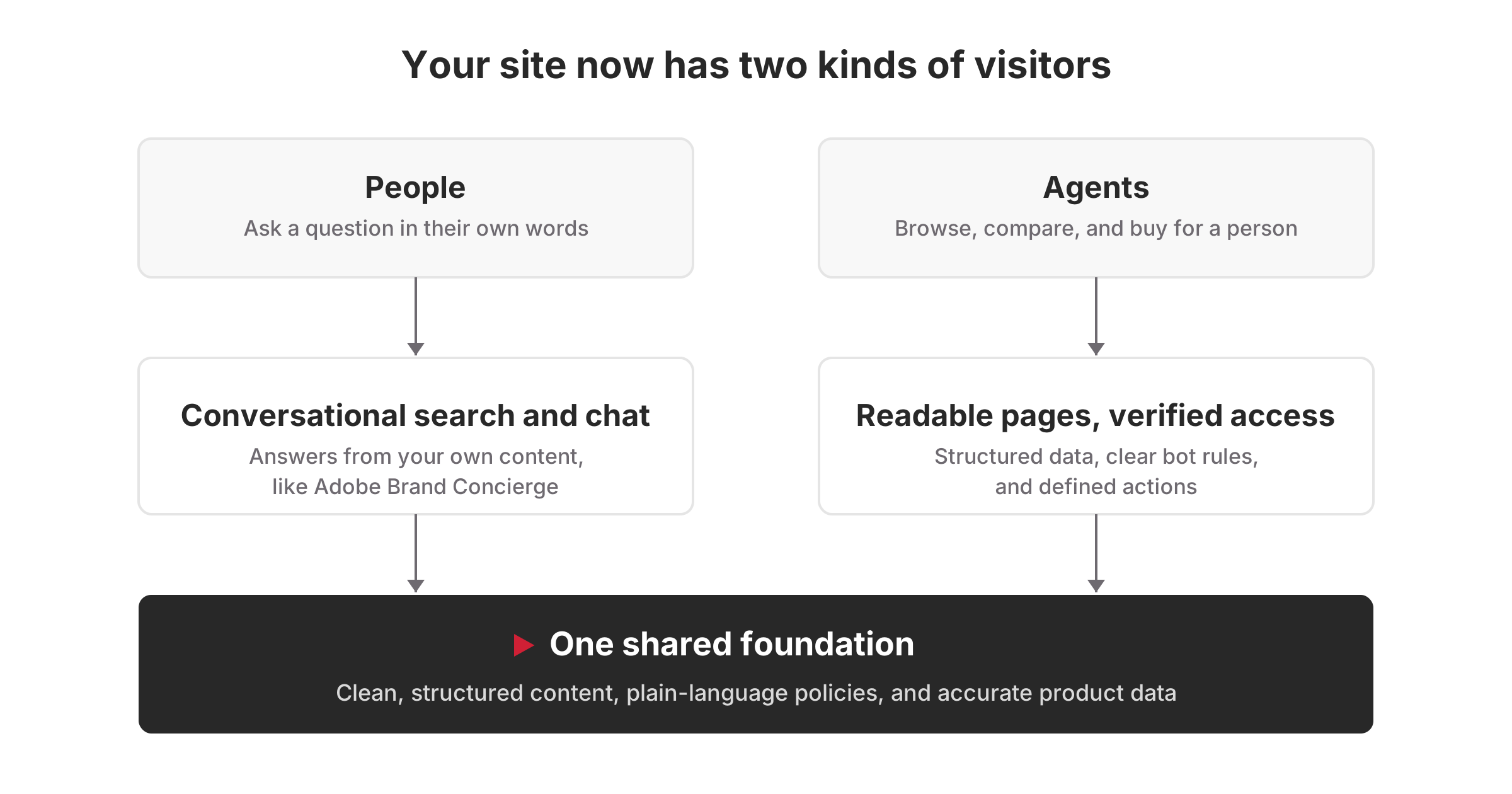
All of them do their work on other people’s websites, and most brands haven’t planned for that. Your site now has two new kinds of visitors. People who expect to ask a question and get a real answer, the way they do in ChatGPT. And the agents working for those people, who need to read your pages and finish a task. Both want clear answers they can act on.
What personal agents can and can't do
Personal agents can already shop, book, and fill out forms on the open web. They still stop short in a few predictable places, and a lot of those places are on brand websites.
| Agent | Can do today | Checks with you first | Can't do yet | Who can get it |
|---|---|---|---|---|
| Muse | Shop and check out, book travel, fill out forms, send email, work on lowering bills | Sending an email or making a purchase | Get past sites that block it, like Amazon. Available in the US and Canada so far | Free, with $20 and $100 monthly tiers |
| dots | Work toward a goal in the background, research across connected tools, buy with a card saved on a merchant's site | Purchases, recurring messages, and deleting data | Change passwords or move money (you have to take over). Get through some sign-in and security checks alone | ChatGPT Pro and Business Premium |
| Grok Bot | Sign into sites and portals with no API, repeat routines you teach it, pass work to other bots | Sending, posting, buying, or deleting | SpaceXSI hasn't published limits. It's still in beta | Beta, included with SuperGrok and Cursor plans |
How brands can get ready for personal agents
Getting ready doesn't mean picking an agent. It means making sure any of them can get in, read your pages, and finish the job.
Let the right agents in
Muse can only finish a task if the site lets it in. In late September, Amazon began blocking Muse from its retail site, TechCrunch reported, citing Bloomberg. Walmart is a Muse partner and still saw it fail when the agent hit a click-to-verify bot challenge. So even the big companies struggle with telling a customer's agent apart from a bot. But that's where you can make it your advantage, because an agent that gets turned away at one store will end up moving to the next.
DataDome found Muse doesn't identify itself as an AI agent, and 99.3% of the Muse requests it sampled came from cloud and CDN servers. That’s the same kind of traffic scrapers come from, so many bot tools treat it as suspicious. Without a way to tell a customer’s agent from a scraper, sites end up blocking both, or letting both through.
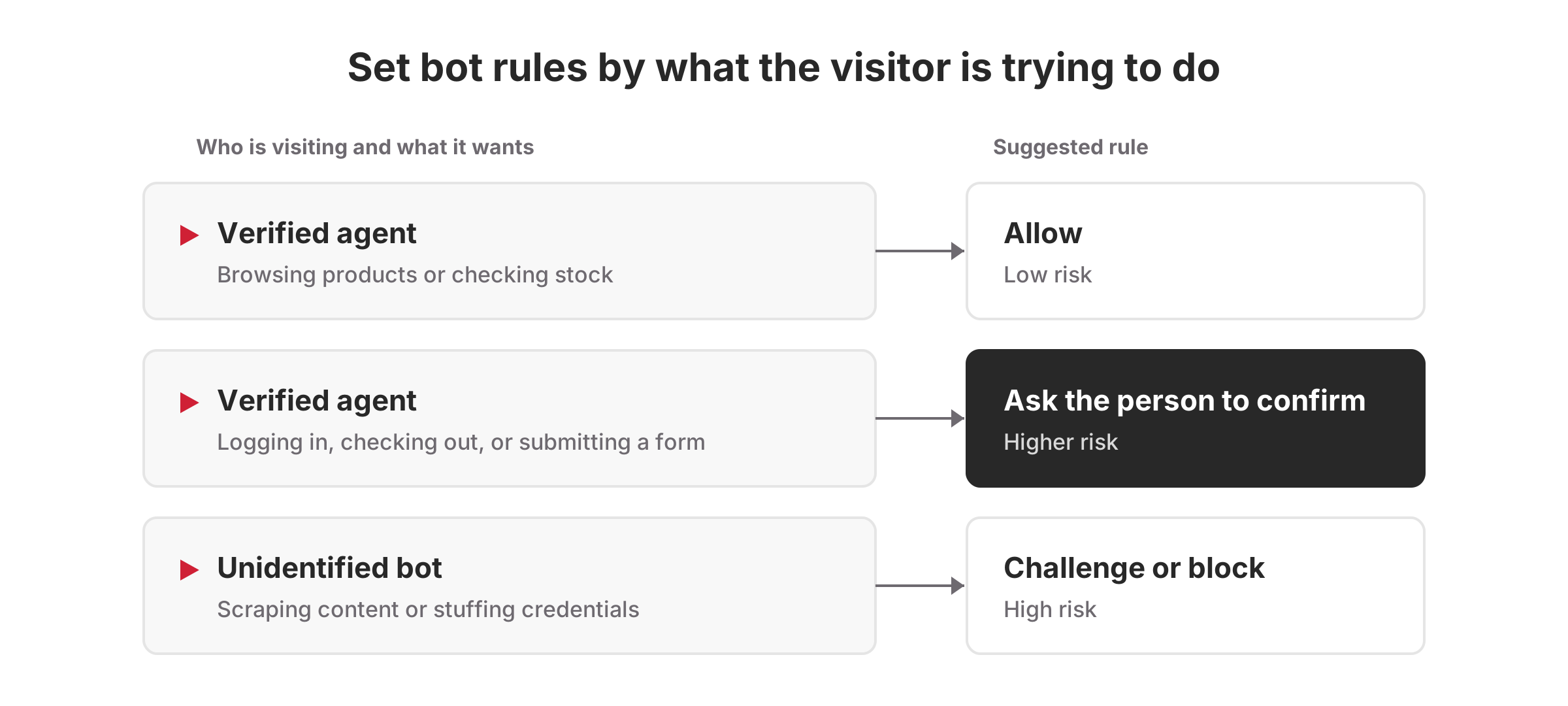
What you should do is look at what's getting blocked with whoever owns your CDN or security tools. Then set rules by the action an agent is attempting. For example, read-only requests like browsing products or checking stock are typically low risk. Authenticated or state-changing actions, like logging in, checking out, or submitting a form, may still need a person to confirm.
Make your pages readable to AI
Once an agent gets in, it has to understand what it finds. Adobe found that US retail product pages are only 66% machine-readable on average.
You can check your own pages in about a minute. Our free AI Readability Check reads a page with and without JavaScript, checks your robots.txt rules for AI crawlers, and parses your structured data. Then it gives you a score and the fixes that raise it. Try a product page first, since that's where the gaps usually are.
The bigger project behind all of this is your data. Product attributes, taxonomy, and one source of truth per question decide what an agent can find and repeat. We’ll cover that in more detail in an upcoming post.
Get ready for agents that check out
Agents that buy things work best when they don’t have to click through a cart built for people. Google’s Universal Commerce Protocol (UCP) gives agents a standard way to read your catalog and complete checkout. OpenAI’s Agentic Commerce Protocol (ACP) started out doing the same, but since March it surfaces your products in ChatGPT and sends shoppers to your site to buy. Our post on whether Adobe Commerce has UCP covers where that stands on Adobe.
If you sell on Adobe Commerce or Magento, our free UCP and ACP readiness assessment shows the current status of what's ready and what's missing before you commit to a build.
How to use personal agents to your advantage today
You don't have to wait for these standards to settle. Here are three things you can do with these agents right now.
Run your own site through an agent
The cheapest research you can do this month is to act like your customer's agent. Give Muse or ChatGPT's agent the five tasks your customers do most, like finding a product, checking a return policy, or booking a demo. Then keep an eye on where it stalls. Some scenarios you’d never expect, such as a bot challenge, a product spec stuck in an image, or a form that won’t submit, can stop an agent cold. Each stall is a spot where a real customer's agent gives up too.
Put your own agent in front of customers
Bain says shoppers report trusting a retailer's own on-site agent three times more than a third-party one, "for now." Every question asked on your site is one you get to answer and learn from.
For brands running on Adobe, Adobe Brand Concierge is the natural place to start. It runs conversations on your site that are grounded in your own content and guardrails. It can draw on your product catalog and send in-chat leads to Marketo Engage. Our closer look at Brand Concierge covers how it works with Adobe Commerce.
Use agents on your own team
Personal agents aren't only something that happens to your site. They're useful inside your team too. A dot can keep an eye on competitor pricing pages or new reviews and flag what changed. A Grok Bot routine can pull the same monthly report from a vendor portal you'd otherwise log into by hand. Start small and keep a person reviewing the output. You'll learn how these agents behave before your customers' agents start testing your site.
Where personal agents are headed
Nobody knows yet which agent will come out on top. But a few directions are already clear from what’s shipping now and the standards taking shape around it.
Your agent will talk to their agent
Today a personal agent mostly clicks through pages built for people. The next step is agents talking to agents. Gartner predicts that by 2028, 60% of brands will use agentic AI for one-to-one interactions, with agents acting as ongoing concierges across marketing, sales, and support. In that world, a customer's Muse asks your Brand Concierge a question instead of reading your returns page. The brand with an agent ready to answer gets the conversation.
The sale won't always happen on your site
Google’s Universal Cart already holds items from several retailers in one place across Search and the Gemini app. Google’s Universal Commerce Protocol (UCP) is built to let agents complete checkout without loading your cart page. Your site doesn’t go away in that world. It becomes the source the agent trusts for price, stock, and policy, which raises the stakes on keeping that data right.
Trust is the real bottleneck
The technology is moving faster than shoppers are. Only about one in ten will let AI make a purchase decision today. Gartner's advice is that the brands that earn trust will use AI to give people more control, not less.
That's our bet too. Agents that show their work, ask before they spend, and hand off to a person when they're unsure will win more customers than agents that try to do everything alone.
Where to start
You don't need to pick a favorite agent. Here are three moves you can do to cover most of it.
- Check who you're turning away. Pull a week of CDN logs and bot management reports, and look for agent requests that returned a 403 or got sent to a bot challenge.
- Fix the foundation once. Clean product data, plain-language policies, and current content serve agents and your own search and chat at the same time.
- Run the agent test. Give an agent your top five customer tasks and fix the first place it gets stuck.
With the development of AI moving at such a rapid pace, one thing is for sure: the agents will keep changing, and there will be new features every few months. What your site does when they show up is the part you have the ability to control.
If you want a second set of eyes on what your site is blocking or how it answers questions, we'd love to continue the conversation.
Stay informed, sign up for our newsletter.