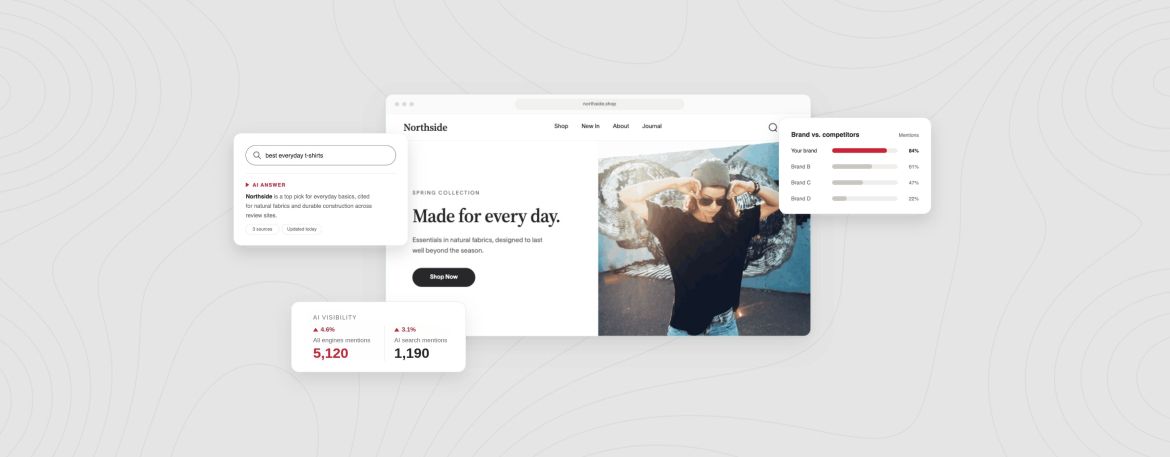
LLM Optimization in 2026: How Adobe and Semrush Work Together for AI Visibility

Author
Kristen Major
Digital Marketing Team Lead (SEO)
The pivot from SEO to GEO
The search landscape is changing fast, and if you work in marketing, you've probably been feeling the impact over the last few years. Your customers still open Google, but a lot of their journeys now start with ChatGPT, Claude, Perplexity, Google AI Mode, or Copilot instead.
Search has changed from "link-based" to "answer-based," meaning customers are searching without clicking on results more than ever before. Customers get one synthesized answer rather than a page of links, and they often act on it without clicking through to any website. That's great for the brands the AI mentions, but it's a problem for everyone else it leaves out.
Our SEO team at Northern has been watching this shift closely. The short version is that getting found now means optimizing for the AI, not just the search engine.
We are already starting to see it in the numbers. Adobe studies show AI traffic to U.S. retail sites grew 269% year over year as of March 2026. Additionally, a Semrush study of ChatGPT clickstream data found that for most of the period studied, 65% to 85% of prompts did not match any traditional search keyword. Your customers are asking longer, more specific questions than they ever typed into a search bar.
The catch is that most teams cannot see any of this yet. Semrush's 2026 AI Visibility Index found that 45% of marketing leaders cannot accurately measure their brand visibility inside AI answers, and only 9% have the tools to track it across platforms. If that sounds like your team, you are in good company, and there is a way to fix it.
What is LLM optimization
LLM optimization is how you shape your content so large language models mention, cite, and describe your brand accurately when they answer a question. It shares a foundation with SEO. Clean structure, real authority, and trustworthy content still matter, but the target is different. SEO aims for a ranking, while GEO aims for a citation inside a generated answer.
It helps to see how classic search, answer engines, and generative engines line up.
| SEO | AEO | GEO | |
|---|---|---|---|
| What it optimizes for | Ranking in a list of links | A single direct answer, like a featured snippet | Being mentioned and cited inside an AI-generated response |
| What the user does | Clicks through to your site | Reads the answer on the results page | Reads a synthesized answer in a chat or AI search |
| Optimizations | Keywords, links, page speed | Structured answers, schema, concise facts | Semantic structure, entity clarity, content AI can parse and trust |
| What success looks like | Position one | Owning the answer box | Your brand named in the model's reply |
The three build on each other. Strong SEO still feeds the trust signals AI relies on. GEO adds a layer on top for how models read and repeat your content. We wrote more about the risk of ignoring that shift in The Hidden Costs of Relying on ChatGPT for SEO, if you want the fuller picture.
What is Adobe LLM Optimizer
Adobe LLM Optimizer is a generative-AI-first application built for GEO inside Adobe Experience Cloud. The easiest way to think about it is as a brand translation layer. It tells you how AI models currently read your brand, where you show up, where you do not, and what to change.
Adobe LLM Optimizer runs on a simple loop
- The program auto identify finds where your visibility is weak.
- It then suggests fixes based on what performs in AI answers.
- Optimizations and fixes are automatically deployed once you approve them. You stay in control, the tool does the heavy lifting.
Key capabilities of Adobe LLM Optimizer
Here are the features our team leans on most.
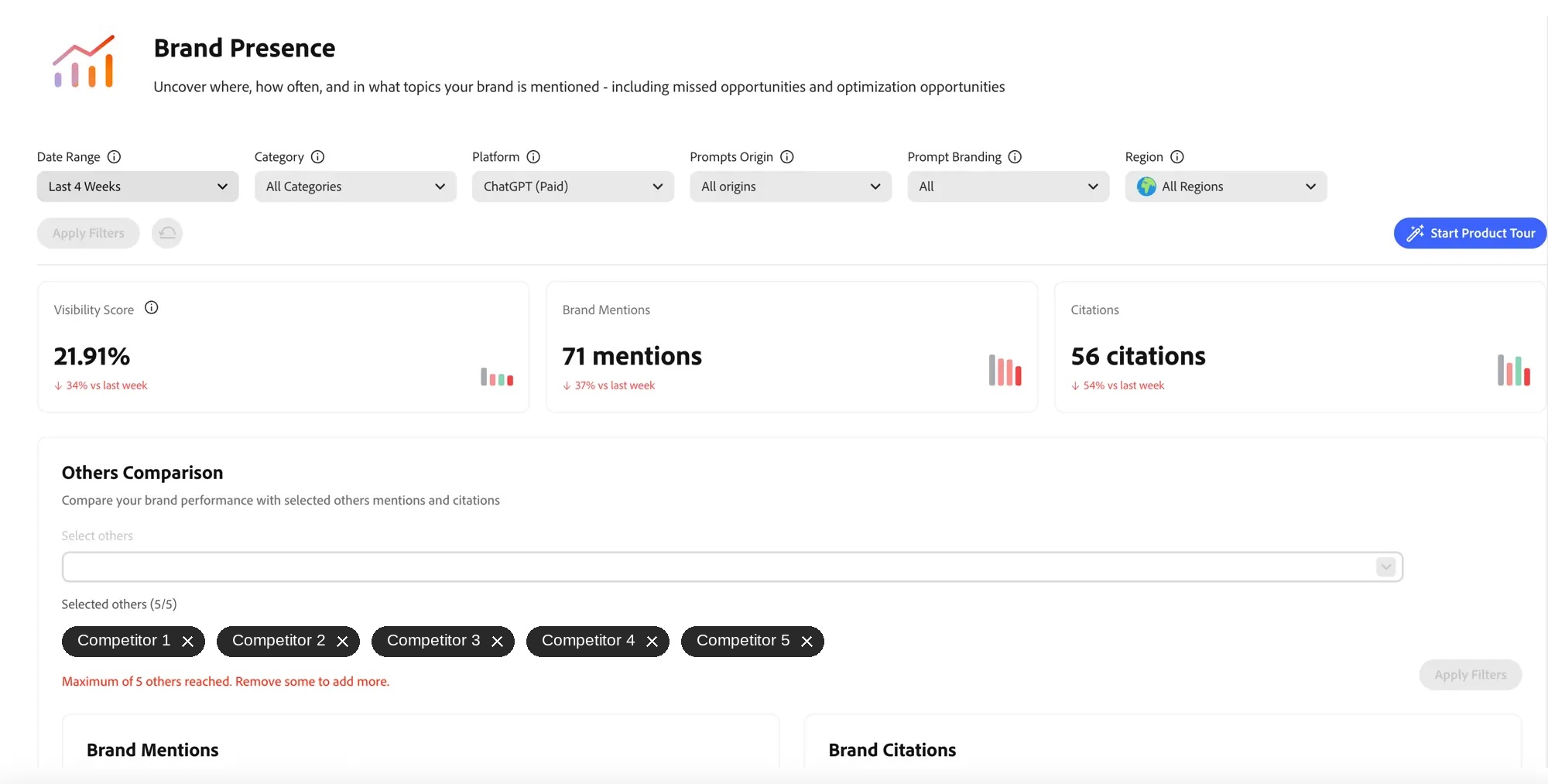
- Brand presence monitoring. It benchmarks your mentions, sentiment, share of voice, and citation frequency against competitors across several AI platforms at once. You get to see where you actually stand instead of guessing.
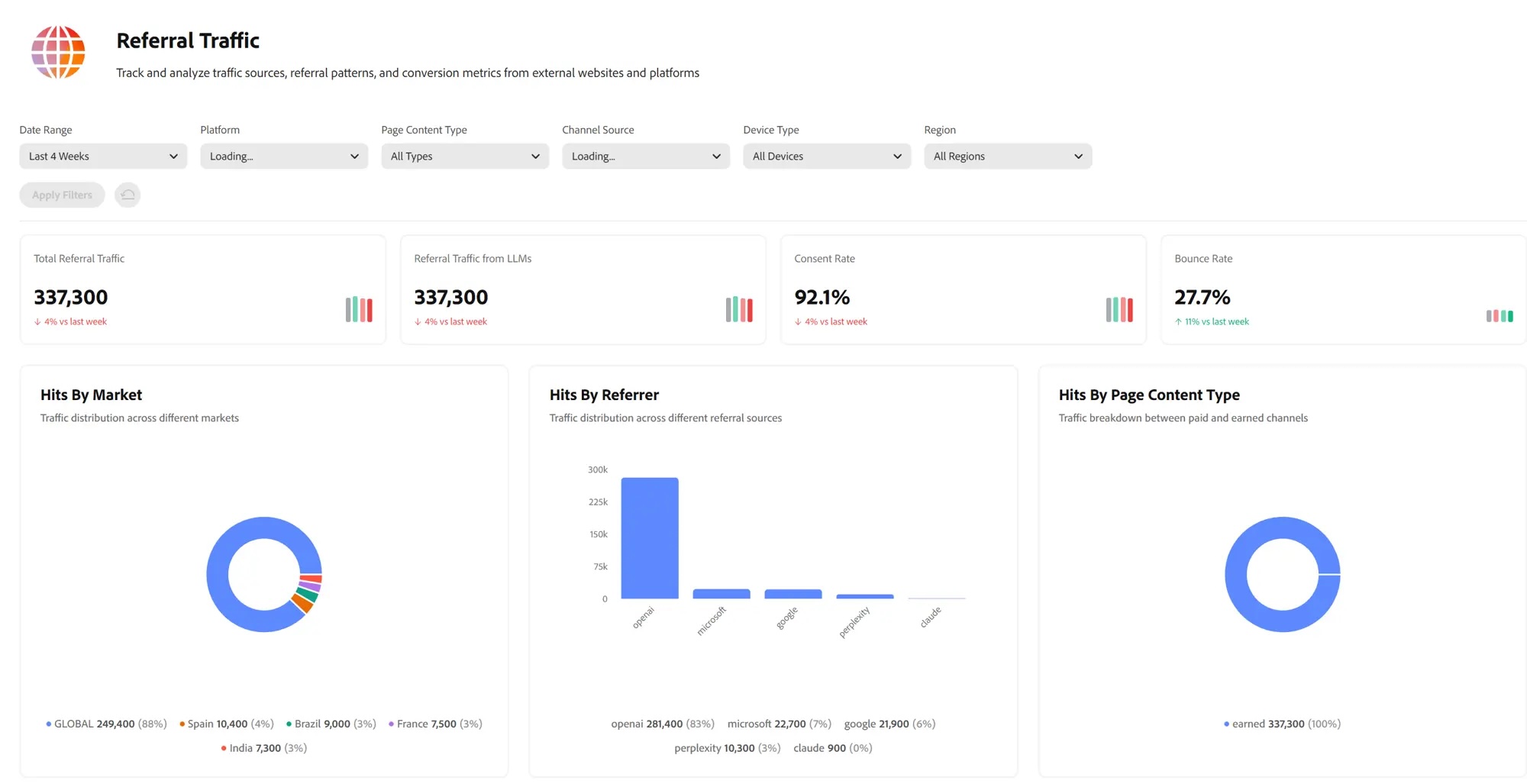
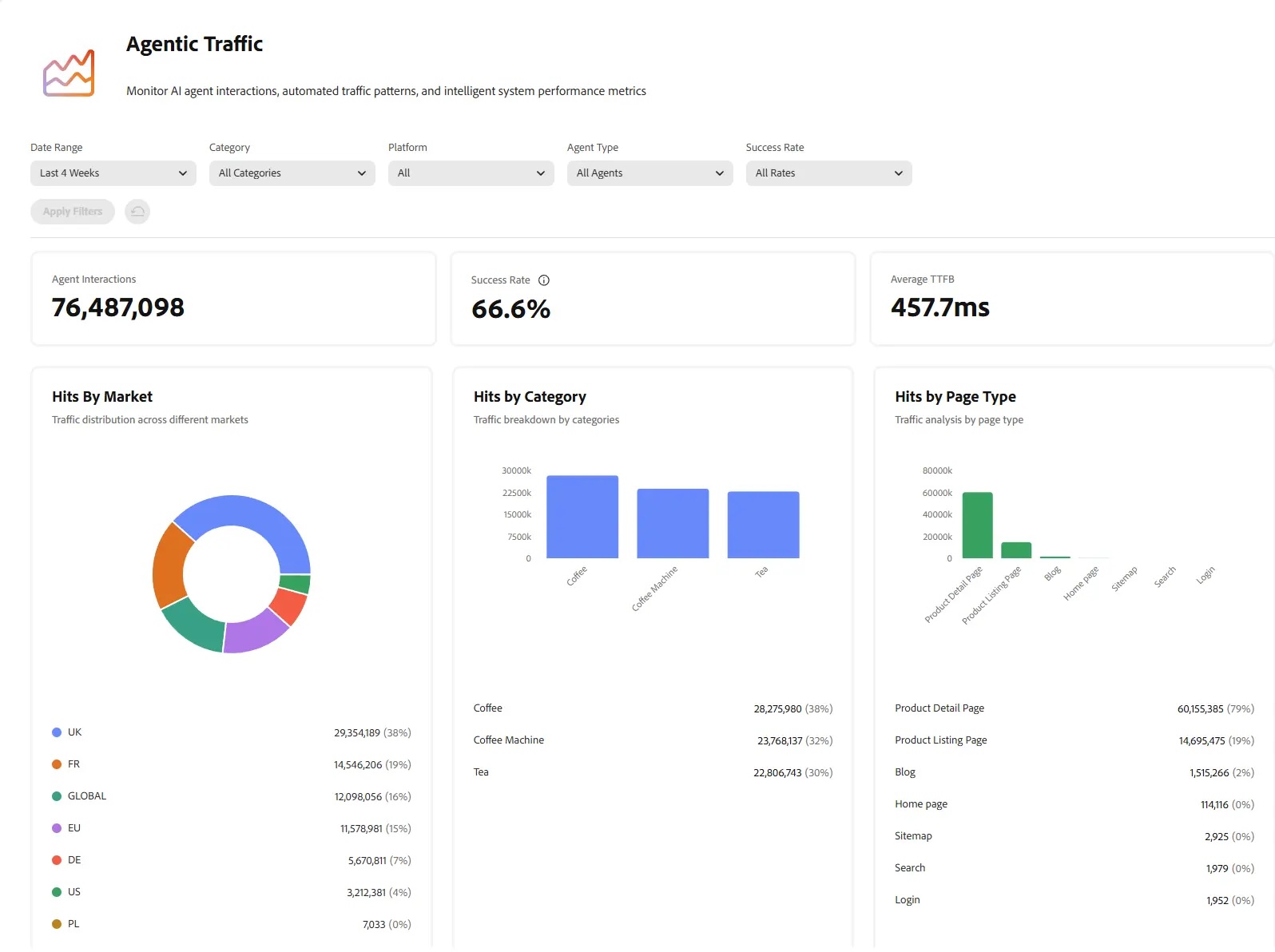
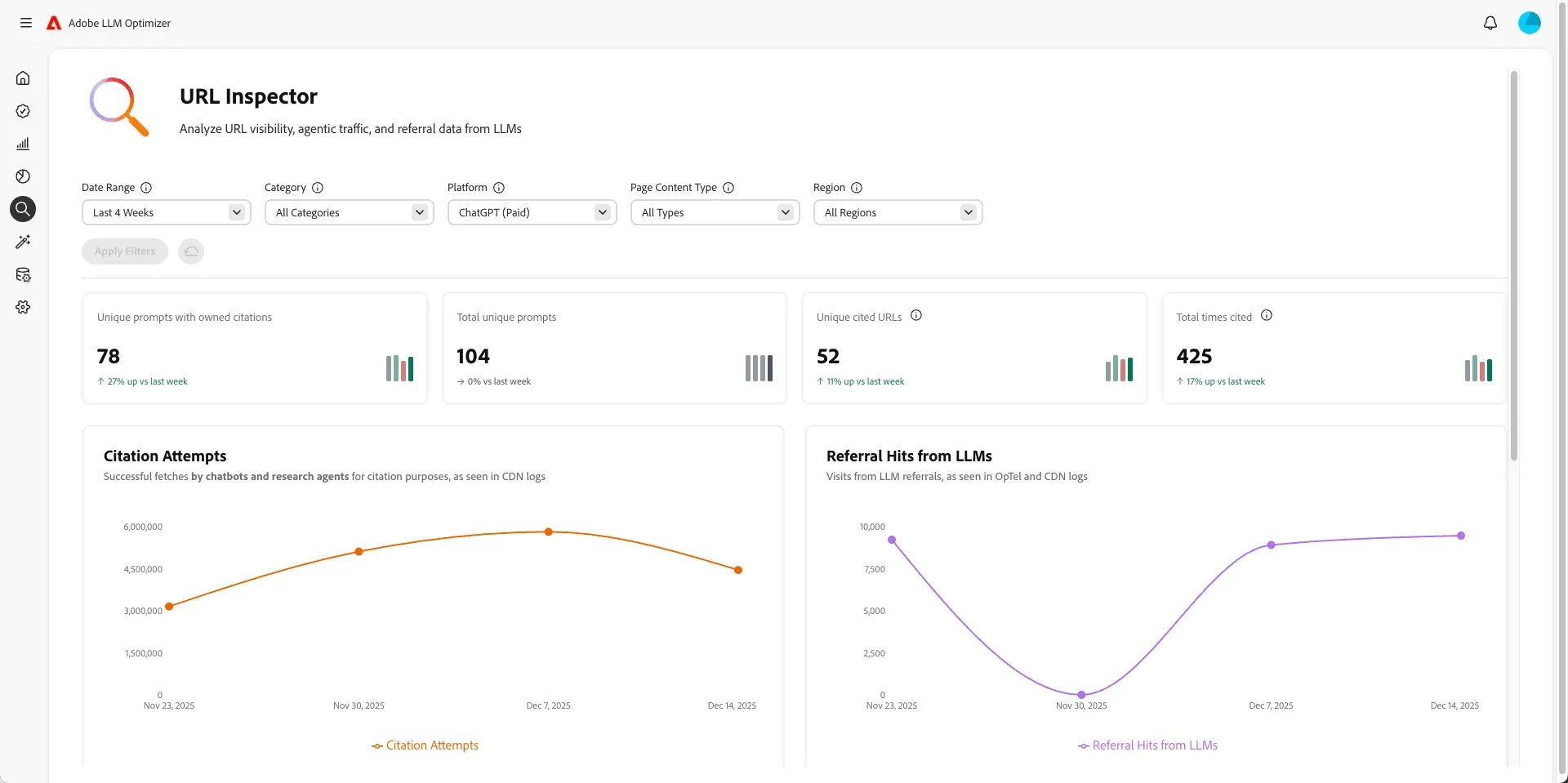
- Agentic traffic tracking. Standard analytics only count human visitors. LLM Optimizer measures agentic traffic, meaning the AI bots, crawlers, and scrapers hitting your URLs. That shows you which of your pages the models treat as authoritative.
- Optimize at edge. This is the one that turns heads. Instead of waiting months for a developer to change site code, LLM Optimizer can push AI-friendly updates straight to the CDN edge in minutes. The changes target AI agents, they roll back instantly, and they leave the experience for your human visitors untouched.
The AI tech toolkit, software, checkers, and tools
A whole category of tooling has grown up around AI visibility in the last year, and the good platforms share a few traits. They pull from real AI search behaviour, not guesswork. They separate mentions from citations, since being named in an answer is not the same as being the source it cites. And they connect visibility back to traffic and revenue.
Adobe and Semrush cover different ground here, and that is the point.
- Semrush prompt research and tracking. Semrush treats prompts a lot like keywords. It surfaces the high-volume prompts in your category where your brand is missing, so you can see exactly where competitors are taking share before you lose more of it.
- Adobe ecosystem scanning. Adobe looks at your footprint on the channels you do not own but models trust, places like Wikipedia, Reddit, and community forums. A lot of what an AI says about you comes from sources you never touch, and this is how you find them.
For a sense of the scale behind this, Semrush maintains a corpus of 28.5 billion keywords and 43 trillion backlinks built over 17 years, on top of its AI prompt database.
Why Adobe LLM Optimizer and Semrush are the winning pair
The integration gap most tools miss
Most AI visibility tools treat prompt research and brand monitoring as separate features in separate dashboards. You find a gap in one tool, go fix it somewhere else, then hope you can measure the result. The steps do not connect, and the work falls through the cracks.
The pairing of these tools, Adobe and Semrush, is different because it was built to be one system, not two products bolted together after the fact. Since Adobe acquired Semrush, the data layer and the execution layer live in the same place.
AI is now intrinsic to the default search experience, and brands need to adapt.
— Andrew Warden, Vice President of Marketing, Adobe
Adobe LLMO & Semrush for Brand Visibility
So, which one should you pick? In June 2026 Adobe launched Adobe Brand Visibility, a single GEO product that combines Adobe LLM Optimizer with Semrush's AI optimization data. It closes the loop between finding out how you show up and actually doing something about it.
Adobe Brand Visibility draws on nearly 300 million real-world AI search prompts, which Adobe calls the largest database of its kind. It tracks your share of voice across ChatGPT, Claude, Perplexity, Google AI Mode, Copilot, and more, and it benchmarks you against your direct competitors. You can run it on its own or plug it into Adobe Experience Manager, and it ties visibility back to revenue inside Adobe Analytics and Customer Journey Analytics.
| Capability | Adobe LLM Optimizer | Semrush | Together as Adobe Brand Visibility |
|---|---|---|---|
| Prompt and gap intelligence | Now integrating Semrush's prompt database | Nearly 300M prompt database, missing-prompt analysis | Semrush data feeds straight into the workflow |
| Brand presence and share of voice | Yes, across major LLMs | Yes, with historical comparison | Unified view across platforms and competitors |
| Content and technical fixes | Prescriptive recommendations | Surfaces the gaps | Recommendations built from Semrush's gap data |
| Deploy at the edge | Yes, CDN edge in minutes | No | Fixes go live without a dev sprint |
| Tie to revenue | Agentic and referral traffic | SEO and traffic signals | Native Adobe Analytics and CJA reporting |
Data intelligence meets enterprise execution
The best part is that you do not have to choose between Semrush's data and Adobe's infrastructure.
- Semrush surfaces the citation gaps and the high-volume prompts where you are absent.
- Adobe LLM Optimizer turns those into content recommendations and pushes them live, often in minutes.
One tool finds the problem, the same tool fixes it, and the reporting environment your team already uses tells you whether it worked.
How to audit and optimize for LLMs
You do not need both tools to get started, and you do not need a giant program. An initial review of your website performance within LLMs comes down to three steps.
Step 1: Audit your brand visibility on LLMs with Semrush
Use Semrush's AI Visibility Toolkit to set a baseline. Find where your brand shows up across AI platforms today, then map the competitive gap with the AI mention data to spot the high-traffic prompts where you get left out. Keep this high level for now. You are hunting for the biggest gaps, not every gap.
Step 2: Content optimization and structuring with LLM Optimizer
Take those prompt gaps into Adobe's Opportunities dashboard. Fix the crawlability issues first, like AI bots blocked by an old robots.txt file, since a model cannot cite what it cannot read. Then add the structure that helps models parse your content, things like clear headers, FAQs, and semantic tables.
Deep learning vs machine learning in AI search
Here is why structure beats keyword density now. Older SEO leaned on basic pattern matching. Large language models run on neural networks and deep learning, so they read semantic and relational context instead of counting words. Your goal is to build a clear knowledge graph around your products and topics, so the model understands how everything connects. Stuffing keywords does not help, and it can hurt.
Step 3: Monitor results and re-optimize
GEO is a loop, not a launch. Keep watching competitors, looking for gaps you can fill, and keep an eye on how your audience actually talks about your brand in their prompts. Re-optimize on a regular cadence, because AI answers shift week to week.
Common Questions about Adobe LLM Optimizer and Semrush
Can I use Adobe LLM Optimizer without Semrush?
Yes. Adobe LLM Optimizer works on its own and integrates with Adobe Experience Manager, Adobe Commerce, and other platforms. The Semrush data makes the prompt and gap intelligence deeper, but you can start with LLM Optimizer alone.
Does LLM optimization replace traditional SEO?
No. It builds on it. Strong SEO fundamentals still create the trust signals models rely on. GEO adds a layer for how AI systems read and repeat your content.
How long does it take to see results from LLM optimization?
It varies by site and category. Edge deployments can go live in minutes, but AI answers update on their own schedule, so visibility changes tend to show up over weeks, not days. The teams that treat it as an ongoing loop see the steadiest gains.
Winning the future of AI search
The ground has moved, and yesterday's spreadsheet-driven SEO habits cannot keep up with it. The brands that stay visible are the ones treating GEO as its own discipline, backed by real prompt data and the ability to act on it quickly. With Semrush surfacing the gaps and Adobe pushing the fixes live, you can turn what you learn into real changes on your site.
This is the kind of work our team does every day. As an Adobe-first partner, we run AI visibility audits, find the answers where your brand is missing, and build a plan to close the gap. If you want the bigger picture on using AI in content without losing your edge, our webinar on AI and content strategy covers it. If you're not sure where to start, let's connect.
Stay informed, sign up for our newsletter.