What Is Agentic Commerce and Why It Matters in 2026
Every so often, a new disruption enters the world of retail and fundamentally reshapes what feels normal. Google Search revolutionized how consumers discovered new products and services. Amazon changed the way we shop through discovery and reviews. Social media introduced new acquisition dynamics such as influence, community and algorithmic feeds. In more recent years, assistive AI has started to help retailers create personalized experiences, predict demand, and optimize marketing operations. Each shift expanded the market but rewarded the brands that adapted early and thoughtfully.
As we head into NRF 2026: Retail’s Big Show, a new inflection point has come into focus across retail and marketing: agentic AI and, with it, agentic commerce.
And this isn’t just some trendy AI feature like implementing an AI bot for your ecommerce store, or an AI marketing automation tool to give you a marginal bump in productivity. This is a new, structural shift in how decisions get made, how visitor experiences are delivered, and how value is created across retail and marketing.
The Shift from Assistive AI to Agentic AI
“This dramatically changes the internet landscape and the tech landscape over the next two or three years. If you didn’t figure out how to interact with customers on the internet, you were going to lose market share.”
— Mark Mahaney, Evercore ISI, on CNBC
Most major retailers are starting to take note. In fact, a survey done by Nvidia shows that 9 out of 10 retailers are already employing some form of AI. Product recommendations, forecasting models, chatbots, and personalization engines have become the norm for most. Brands like Amazon, Nike, Sephora, and Wayfair already rely on AI heavily to personalize experiences, optimize assortments, and predict customer demand.
But many of these organizations are now pushing beyond assistive AI tools, exploring agentic approaches that can act more autonomously, break previous silos by allowing better coordination, and work toward execution rather than recommendations alone.
“Agentic AI refers to systems designed to act autonomously as agents on behalf of their human users.”
— Bernard Marr, Futurist and Author
These systems do more than respond to prompts. They are designed to:
- Act more independently (clearly defined guardrails are important here)
- Learn from outcomes and adapt over time
- Work toward clear goals rather than completing isolated tasks
- Coordinate across tools, platforms, and data sources
The key difference between Assistive AI and Agentic AI is that the latter initiates action. It doesn’t need to be told what to do at every step.
So What Exactly is Agentic Commerce?
The simplest answer is this: When agentic AI is applied to retail and marketing use cases, it becomes agentic commerce. But that definition, however, benefits from a bit more context.
Traditional eCommerce is largely user-driven. Customers themselves do the searching, browsing, comparing, reviewing, and purchasing with different products or services. Agentic commerce mainly differs from that by being goal-driven. What does this mean you ask?
Well, instead of asking a system to simply recommend products (traditional ecommerce), an agent can:
- Observe user intent, product inventory, pricing controls, and context (such as purchase history, preferences, location, and timing)
- Decide when and where to act (including selecting the optimal channel, timing an offer or reorder, adjusting pricing or promotions within approved limits, etc.)
- Execute tasks across multiple systems, such as commerce platforms, inventory management, marketing automation, loyalty programs, and fulfillment workflows
- Optimize outcomes over time by learning from results, refining decisions, and then continuously improving performance against defined business and customer experience goals.
So by building on generative AI techniques by using LLMs to function in dynamic environments, agentic AI can generate outputs toward specific goals rather than just recommendations. So for example, instead of asking OpenAI’s ChatGPT “When is the best time to visit Australia?” while including your work schedule, an AI agent would be able to answer that question by booking the flight and hotel for you.
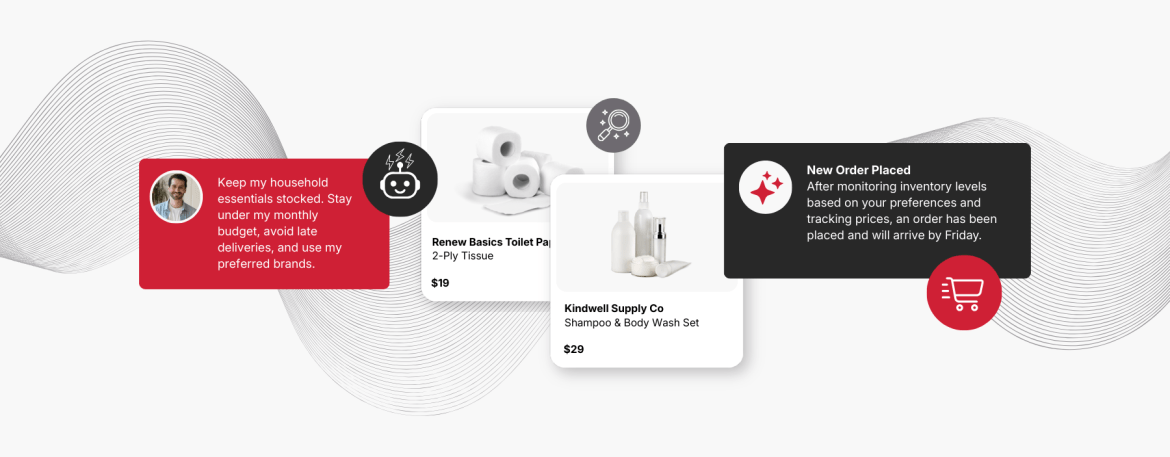
To make this resonate better, let’s consider a modern retail scenario.
Instead of a customer repeatedly searching for products, comparing price differences, checking availability, or deciding when to buy, an agentic commerce system can be given a goal. For example, instead of repeatedly shopping for the same household essential products on a monthly basis, a customer might say (or set via preferences):
“Keep my household essentials stocked. Stay under my monthly budget, avoid late deliveries, and use my preferred brands.”
From that point on, the agent can then:
- Monitor inventory levels to set consumer preferences
- Track pricing and promotions across retailers like Amazon, Target, or Walmart
- Decide when conditions are optimal to place an order
- Complete the purchase and confirm delivery
From then on, the customer won’t have to browse and order products manually. They set the intent once, and the agent handles execution within the defined constraints. Over time, the agent removes the risk of running out of toothpaste, toilet paper, or whatever essential items the customer typically needs to give them peace of mind.
For the brand side, the same principle exists. A retailer might deploy an agent to monitor campaign performance, inventory pressure, and customer behaviour, then automatically adjust offers, messaging, or channel mix in real time.
For example, if a retailer is running a Mother’s Day promotion across email, paid media, and onsite experiences, an agent can continuously monitor inventory levels for popular Mother’s Day items such as flowers, jewelry or chocolate. If specific product inventory tightens (let’s say flowers are near being sold out), the agent can automatically shift messaging toward higher-margin alternatives, reduce paid spend on low-availability items, and update onsite recommendations, all within preapproved rules set by the marketing and commerce teams.
In this case, the agent is not recommending what to do. It is executing within defined guardrails, while humans retain oversight around governance, compliance, ethical use, and alignment with brand and business objectives.
This is where commerce begins to feel less like software and more like a digital teammate working on the customer’s behalf.
Why Brands Need Their Own Agents
Agentic commerce will not live in a single interface or platform.
Marketplaces, operating systems, and AI assistants will all shape how and where customers find products and make decisions. But if you only operate through third-party agents, you give up control of your data, brand expression, and the customer experience itself.
The way to truly differentiate will be through brand-owned agents built on trusted first-party data, governed by clear rules, and aligned to specific customer experience goals.
A practical example
Imagine a customer interacting with a generic AI assistant to find a new pair of running shoes. That assistant might check prices across retailers, surface reviews, and make a recommendation based on availability or cost. The experience is efficient but it is also interchangeable. Every brand looks the same.
Now contrast that with a brand-owned agent built directly on a retailer’s first-party data and systems.
Because the agent is integrated across commerce, content, and customer data platforms, it can operate as a coordinating layer as opposed to a standalone system. Working within the existing permissions and governance models, the agent will be able to:
- Understand the customer’s past purchases, style and fit preferences, and training habits
- Recommend products based on use cases, not just popularity or what’s trending
- Coordinate across commerce, content, and loyalty systems
- Trigger personalized offers through emails, replenishment reminders, or early access to launches
- Maintain brand voice, tone, and design throughout the entire interaction
From the brand’s perspective, the agent is not only assisting customers. It is actively seeking to execute defined goals, such as increasing lifetime value, improving retention, or reducing friction in the purchase journey.
This is where platforms like Adobe Experience Cloud become especially relevant.
Agentic AI in Adobe Experience Cloud
“The best use of AI is to give people more control and free them to spend more time on the work they love.”
— Ely Greenfield, CTO of Digital Media, Adobe
During last year’s Adobe Summit, Adobe revealed its vision for accelerating creativity and productivity through the use of agentic AI and customer experience orchestration. Within Adobe Experience Cloud, agentic capabilities are already available and becoming practical for retail and marketing teams.
Innovations like Adobe Brand Concierge and other purpose-built agents operate within the Adobe Experience Platform, helping teams move beyond isolated AI features toward coordinated execution across commerce operations, data, content, and journeys. Equally important, this foundation also supports the visibility and connectivity needed in an increasingly agent-driven ecosystem.
On the visibility side, Adobe is focused on ensuring brand content, products, and experiences are discoverable by third-party AI agents and large language models. LLMs like ChatGPT are becoming a primary source for consumers as they become increasingly comfortable using it. This shift toward Generative Engine Optimization (GEO) reflects a new reality: product discovery increasingly happens through conversational interfaces and AI-mediated experiences and not just traditional search engines such as Google or Bing.
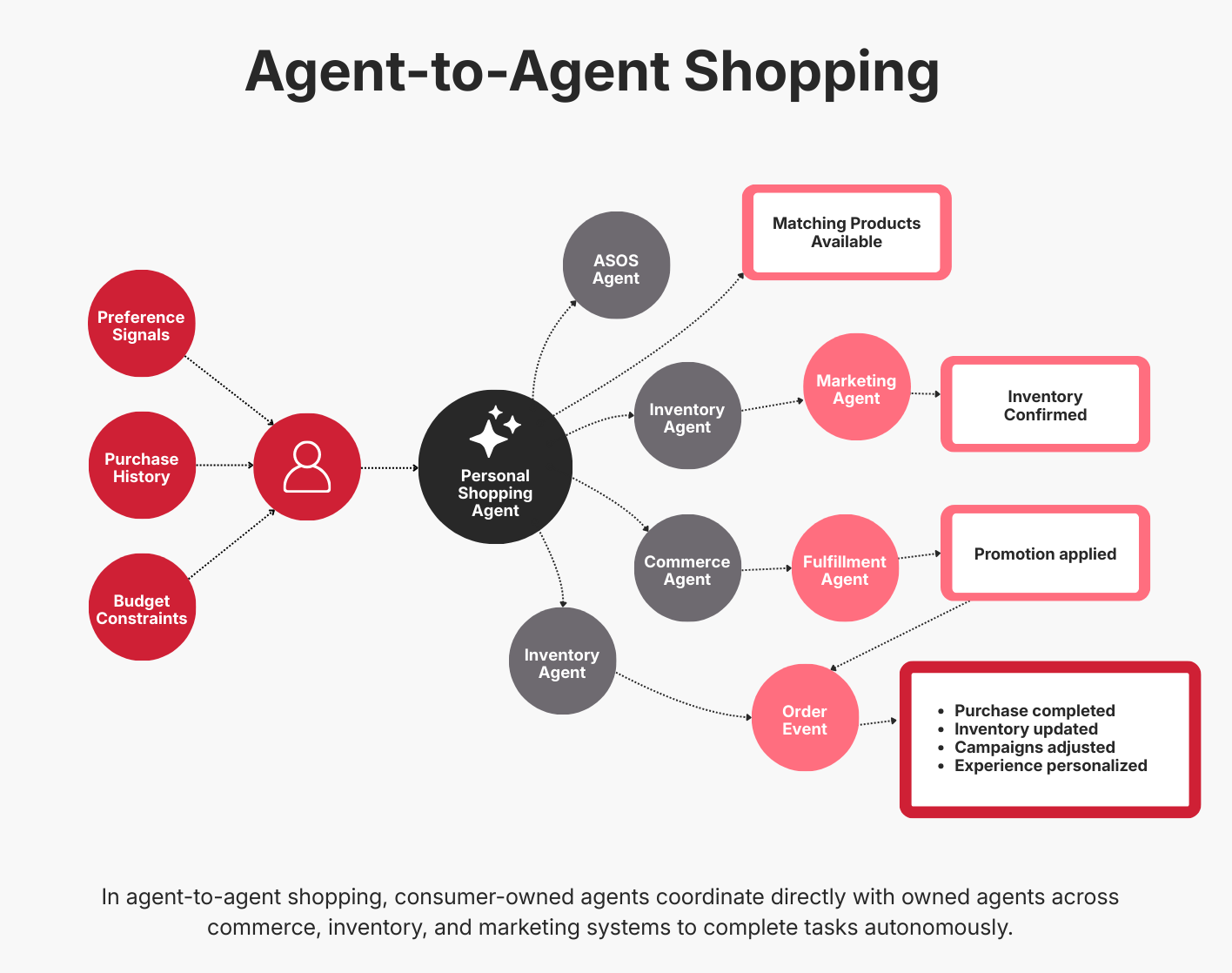
On the connectivity side, Adobe’s platform approach is built for integration across the systems brands already rely on, including commerce platforms, content systems, analytics, and customer data. This helps enable agents to securely coordinate across multiple platforms. As the market moves toward agent-to-agent interactions, this becomes especially critical because third-party agents and brand-owned agents need to exchange context and complete tasks across connected systems.
In practice, this can include agents that:
- Create and optimize audiences using natural language
- Generate and localize content variants at scale
- Surface insights and answer complex data questions
- Design, test, and optimize customer journeys
- Deliver brand-safe, personalized conversational experiences
Marketers will no longer be burdened to manually connect insights to action, as these agents work in the background against defined goals already set by the marketing team. The important takeaway is this: Marketing teams remain in control by setting guardrails, while execution by agents allow for marketing campaigns to move faster and operate more efficiently.
The Future of Modern Retail Teams with Agentic AI
Picture a marketing team unburdened by repetitive, manual processes. A team that no longer spends hours pulling reports, tweaking campaigns, or cobbling together a patchwork of disconnected tools. A team with the time and space to focus on strategy, creativity, and customer experience.
This is the promise of agentic commerce. It doesn’t remove people from the process. It just removes time-consuming friction from the work.
Agentic capabilities are still young. But as they mature, they will fundamentally change how retail teams work, on a day-to-day basis. Marketers will be able to move from manual optimization to agentic orchestration, which will allow them to focus on defining goals and guardrails while brand-owned agents execute across channels and systems.
Commerce teams will evolve from after-the-fact reporting to real-time action, supported by brand-owned commerce agents that can automate eCommerce administration tasks such as merchandising updates, pricing adjustments, promotion setup, and catalog maintenance. Over time, this same foundation enables brands to create personal-shopper-style agents that can assist customers directly or interact with customer-owned agents in agent-to-agent shopping scenarios.
CX teams, meanwhile, will strike a new balance between autonomy, governance, and trust as they embed guardrails, transparency, and accountability into how agentic experiences are designed, deployed, and managed in the customer journey.
Personalization gets a rethink as well. It becomes less focused on what you show customers, and more on what you do for them. Experiences will become more proactive, acting to anticipate needs and remove friction before customers even encounter it.
For modern retail teams, agentic commerce is more than just a productivity gain. It is a new operating model that brands will need to follow in order, and a shift as significant as any other during the past few decades of technological change.
Will We See You at NRF 2026?
Agentic commerce is no longer just a talking point reserved for marketing gurus on your favourite business channel. It is already taking shape across digital marketing platforms, tools, and customer experiences, and we are excited to talk about where it’s headed.
As retailers gather at NRF, the conversation is shifting from “How do we leverage AI?” to “Which decisions are we comfortable with automating?”
Success-driven brands will be the ones that approach agentic AI with clarity and intention. Brands that anchor it in data. That steer it with strategy and design it around real customer needs.
At Northern, we partner with retailers to navigate these shifts and connect strategy, technology, and experience so today’s decisions support tomorrow’s success.
If you are heading to NRF or simply starting to explore what agentic commerce could mean for your business, we would welcome the chance to continue the conversation.
Stay informed, sign up for our newsletter.